Calculate Waistline Inch Loss for Your Weight Loss Journey
Calories Needed to Burn Using Waistline
Calculate how many calories you need to burn to reduce your waistline
Your Waistline Reduction Plan
To lose 0 inches from your waistline in 0 months:
Weekly calorie deficit needed: 0 calories/week
Monthly calorie deficit needed: 0 calories/month
Daily calorie deficit needed: 0 calories/day
How to Use our Waistline Loss Calculator
1. Enter Your Basic Information
- Gender: Select your biological sex (male/female) as it affects fat distribution.
- Age: Enter your current age in years (18-120).
- Height: Input your height in feet and inches (e.g., 5’9″ = 5 feet + 9 inches).
2. Input Your Waist Measurements
- Waist Unit: Choose between inches or centimeters.
- Current Waist Size: Measure your natural waist (narrowest part above the belly button) and enter the value.
3. Set Your Goal
- Waist Reduction Goal:
- The dropdown will show how many inches you can lose without going below 22 inches.
- Example: If your current waist is 32″, options will range from 1″ up to 10″ (We have set the minimum no less than 22″ waistline size).
- Timeframe: Select in how many months (1-12) you want to achieve this goal.
4. Calculate
- Click “Calculate Calorie Requirements” to see your results!

Understanding Your Results
After submitting, you’ll see:
- Total Calories Needed: Total deficit required to lose your goal inches.
- Weekly/Monthly/Daily Deficit: How many fewer calories to consume per day/week/month to stay on track.
- Calculation Steps: Explains the science (1 inch ≈ 8 lbs ≈ 28,000 cal). Adjustments for your height, age, gender, and current waist size. How the deficit breaks down over your timeframe.
How the Waistline Calculator Works: Formulas & Step-by-Step Process
This calculator estimates the calorie deficit needed to lose inches from your waist based on scientifically accepted formulas, adjusted for personal factors. Below is the detailed breakdown:
1. Core Formula & Assumptions
The calculator uses these foundational principles:
- 1 inch of waist loss ≈ 8 pounds of fat loss (average for most body types).
- 1 pound of fat ≈ 3,500 cal deficit.
- Base calories per inch:
8 lbs/inch × 3,500 cal/lb = 28,000 calories/inch
This means losing 1 inch requires a ~28,000-calorie deficit.
2. Adjustments for Individual Factors
The base formula is modified for accuracy using these variables:
A. Height Adjustment
Taller individuals may need slightly more calories/inch.
- Formula: Height Factor = 1 + (Your Height in Inches – 66″) / 100 *(66″ = reference height for adjustment)*
B. Current Waist Size
Larger waists may require more effort to lose inches.
- Formula: Waist Factor = 1 + (Your Waist in Inches – 32″) / 100 *(32″ = reference waist size)*
C. Age Adjustment
Metabolism slows with age.
- Formula: Age Factor = 1 + (Your Age – 35 years) / 200 *(35 = reference age)*
D. Gender Adjustment
Women typically store more fat in hips/thighs.
- Formula: Gender Factor = 1.1 (Female) or 1.0 (Male)
Final Adjusted Cal per Inch
- Calories Per Inch = 28,000 × Height Factor × Waist Factor × Age Factor × Gender Factor
3. Calculating Total Deficit for Your Goal
Input Your Goal:
- Select inches to lose (e.g., 3 inches).
- Choose a timeframe (e.g., 3 months).
Total Calories to Lose X Inches:
- Total Cal = Calories Per Inch × Inches to Lose
- Example: 30,000 cal/inch × 3 inches = 90,000 cal total
Divide by Timeframe:
- Monthly Deficit: Total Cal / Months
- Weekly Deficit: Monthly Deficit / 4
- Daily Deficit: Weekly Deficit / 7
Example (3 months):
- Monthly: 90,000 / 3 = 30,000 cal/month
- Weekly: 30,000 / 4 = 7,500 cal/week
- Daily: 7,500 / 7 = ~1,070 cal/day
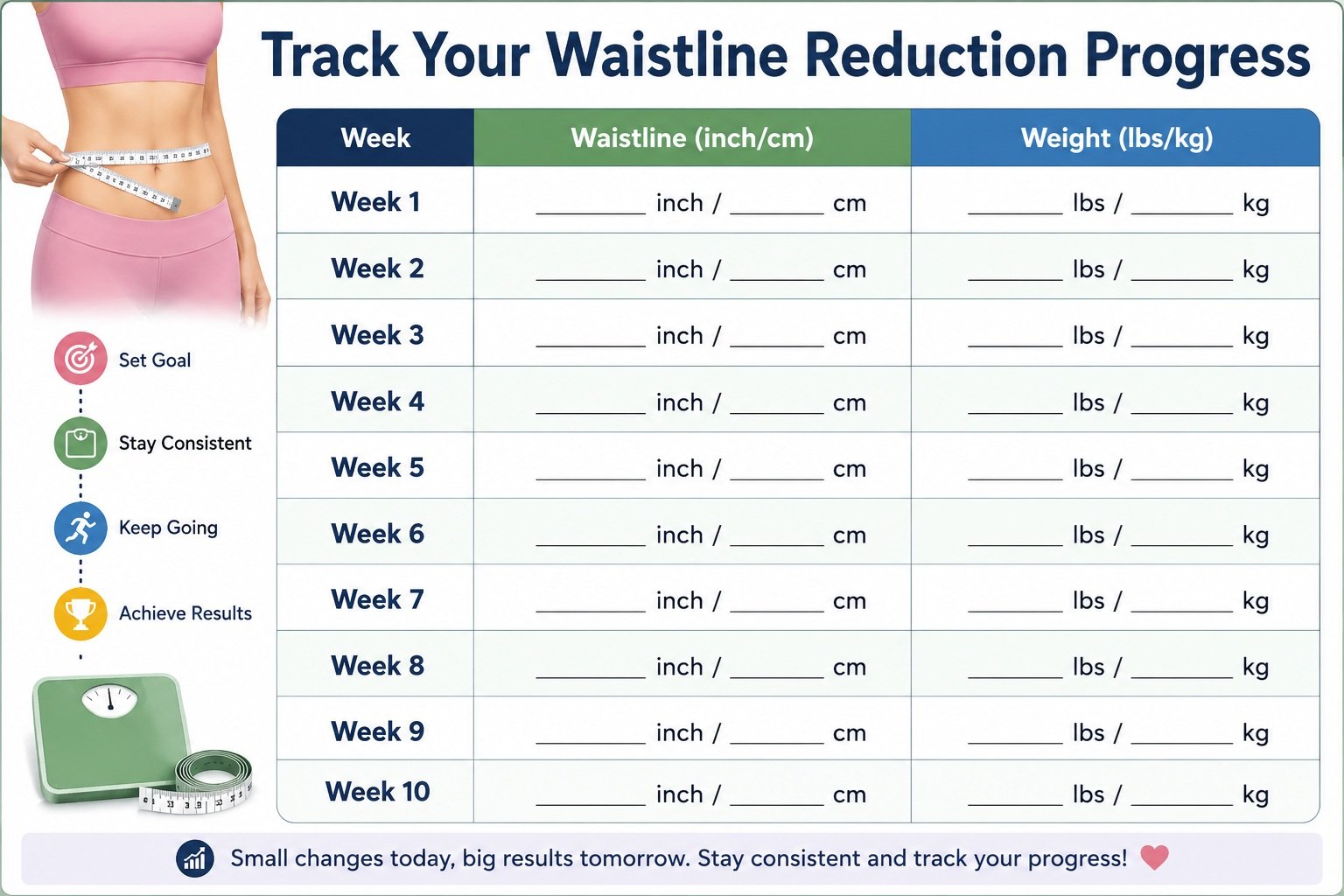
How Calculation Works
Scenario:
- 35-year-old woman
- Height: 5’6″ (66″)
- Waist: 34″
- Goal: Lose 2 inches in 2 months
Step 1: Adjust Calories Per Inch
- Height Factor: 1 + (66 – 66)/100 = 1.0
- Waist Factor: 1 + (34 – 32)/100 = 1.02
- Age Factor: 1 + (35 – 35)/200 = 1.0
- Gender Factor: 1.1
- Calories Per Inch: 28,000 × 1.0 × 1.02 × 1.0 × 1.1 = 31,416 calories/inch
Step 2: Total Deficit
- For 2 inches: 31,416 × 2 = 62,832 calories
Step 3: Timeframe Breakdown (2 months)
- Monthly: 62,832 / 2 = 31,416 cal/month
- Weekly: 31,416 / 4 = 7,854 cal/week
- Daily: 7,854 / 7 = 1,122 cal/day
- Minimum Waist Size: Our calculator prevents goals below 22 inches (health safety).
- Healthy Rate: Targets ~0.5–1 inch/month (1–2 lbs/week).
- Limitations: Individual results vary based on muscle mass, genetics, and adherence.
How to lose fat in general?
1. Create a Calorie Deficit
- Burn more calories than you consume. Use a food diary or app to track intake.
2. Eat a Clean, Balanced Diet
- High in protein, rich in fiber, low in sugar, low refined carbs, less processed foods, and healthy fats.
3. Exercise Regularly
- Cardio: Brisk walking, running, cycling, HIIT
- Strength Training: Build muscle to boost metabolism
- Core Workouts: Planks, crunches (to tone, not spot reduce)
4. Get Enough Sleep
- Aim for 7–9 hours per night. Poor sleep raises cortisol and cravings
5. Manage Stress
- Practice yoga, meditation, or deep breathing. Chronic stress increases belly fat through cortisol
6. Stay Hydrated
- Drink water before meals to reduce calorie intake
- Avoid sugary drinks
7. Limit Alcohol
- Especially beer and sugary cocktails which add empty calories
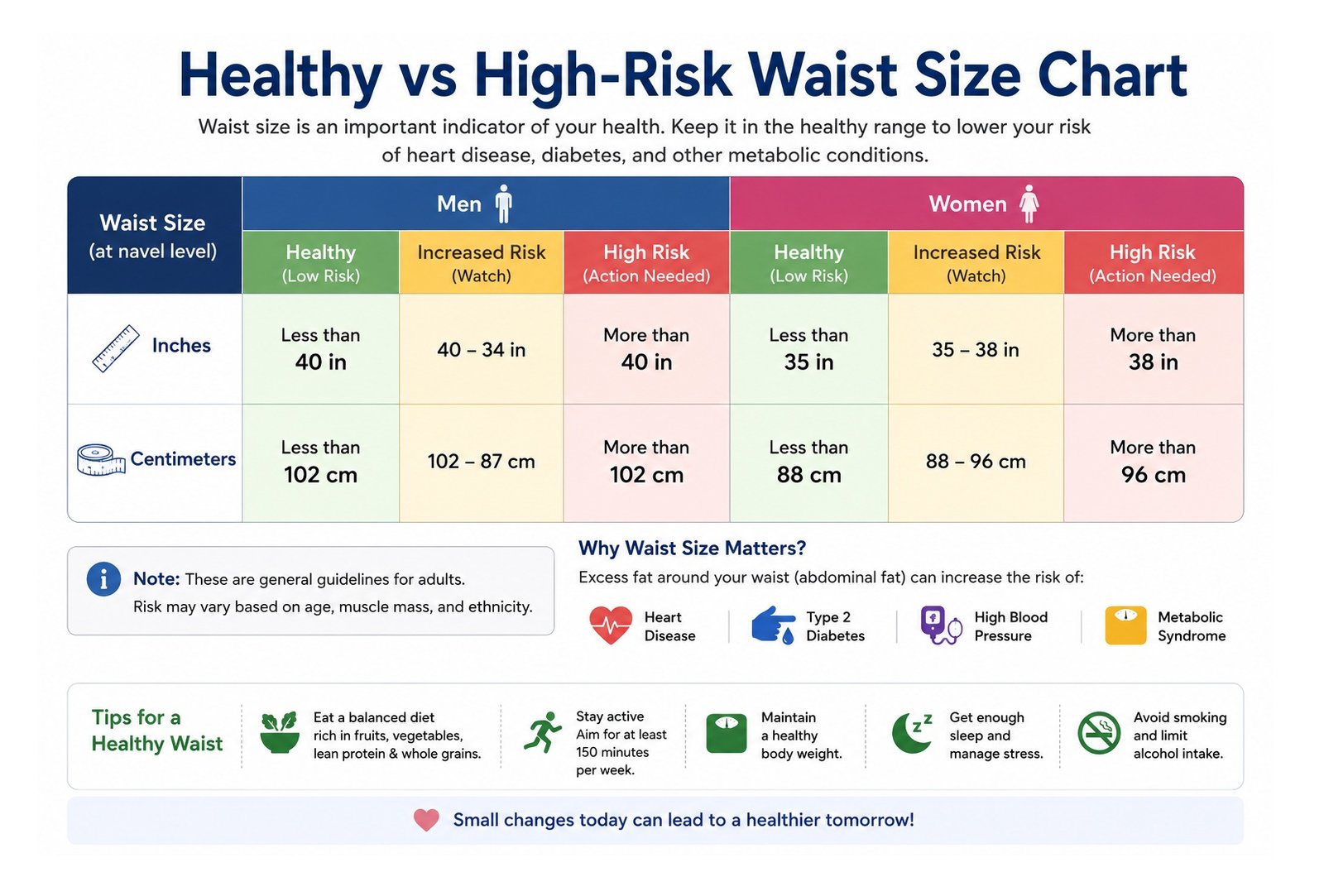
Healthy Waist Size Chart: Understanding Your Waist Measurement and Health Risk
This chart helps you understand whether your waist size falls within a healthy or higher-risk range for men and women.
- Green indicates a healthy waist measurement,
- yellow shows an increased health risk, and
- red represents a high-risk range linked to conditions such as heart disease, type 2 diabetes, and high blood pressure.
Use this chart as a general guide to monitor your waist size over time. Maintaining a healthy waist through regular exercise, a balanced diet, and weight management can help reduce your risk of chronic diseases and improve overall health.
What causes belly fat in males?
In males is commonly caused by a combination of factors.
Key factors include:
- Poor Diet: High intake of sugar, processed foods, and alcohol (especially beer belly).
- Lack of Exercise: Sedentary lifestyle reduces calorie burn.
- Hormonal Changes: Lower testosterone levels with age promote fat storage.
- Stress: Elevated cortisol levels increase fat around the abdomen.
- Genetics: Family history can influence where fat is stored.
- Poor Sleep: Disrupts metabolism and increases hunger hormones.
- Aging: Slower metabolism and muscle loss shift fat toward the belly.
What causes belly fat in females?
In females is caused by a combination of hormonal, lifestyle, and dietary factors.
Key causes include:
- Hormonal Changes: Estrogen fluctuations (especially during menopause) shift fat storage to the abdomen.
- Poor Diet: High sugar, refined carbs, and trans fats contribute to fat gain.
- Stress & Cortisol: Chronic stress elevates cortisol, promoting fat accumulation.
- Lack of Physical Activity: Sedentary habits reduce fat burning.
- Poor Sleep: Disrupts hunger hormones and slows metabolism.
- Age: Metabolism slows with age, and muscle mass declines.
- Insulin Resistance: Linked to PCOS or prediabetes, causing fat storage around the waist.
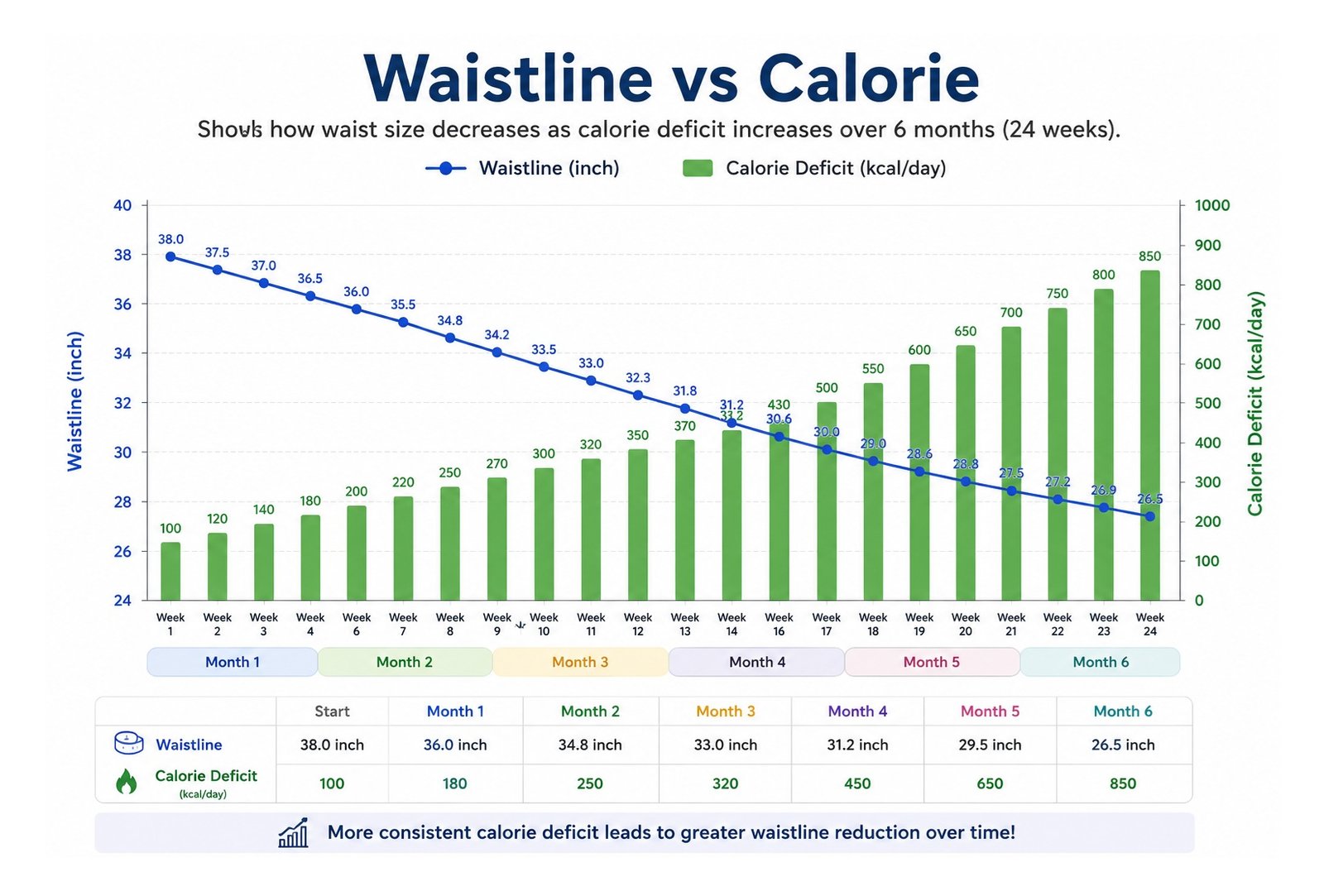
Waistline vs Calorie Deficit
How to Interpret the Waistline vs Calorie Graph
This graph shows how your waistline may change over time as you maintain a calorie deficit. The blue line represents your waist measurement in inches, while the green bars show your average daily calorie deficit. The timeline covers 24 weeks (6 months), making it easy to see gradual progress.
At the beginning, the waist size is larger because little weight has been lost. As the weeks go by, the calorie deficit increases, and the blue line slowly moves downward, showing a reduction in waist size. This illustrates that staying in a consistent calorie deficit can help reduce body fat over time, which often leads to a smaller waistline.
Remember, this graph is meant to show a general trend rather than exact results. Everyone loses weight at a different pace depending on factors such as age, activity level, diet, metabolism, sleep, and overall health. The key message is that steady, healthy habits and consistency over several months usually lead to better long-term waistline reduction than trying to lose weight too quickly.
What causes Waistline fat to accumulate?
Fat can accumulate due to multiple factors including poor diet (high sugar, refined carbs), lack of physical activity, excessive alcohol consumption, stress (which raises cortisol), aging, and genetics. Hormonal changes and poor sleep can also contribute to fat buildup in the abdominal area.
How fat burns naturally?
- A healthy diet rich in whole foods, fiber, and protein
- Regular exercise, including cardio (e.g., walking, HIIT) and resistance training
- Limiting sugar, alcohol, and processed foods
- Getting enough sleep and managing stress levels
Why fat around belly is so hard to lose?
Fat from middle part of the body is hard to lose due to stubborn visceral fat, hormonal imbalances (like high cortisol), poor sleep, and a sedentary lifestyle. Unlike other fat, abdominal fat resists diet and exercise. Targeting belly fat loss requires a calorie deficit, balanced diet, stress control, and consistent fat-burning workouts.
Is visceral fat more dangerous than fat in other parts of the body?
Yes, fat especially visceral fat (fat surrounding internal organs), is linked to higher risks of type 2 diabetes, heart disease, high blood pressure, and certain cancers. It’s more metabolically active and harmful than subcutaneous fat found under the skin.
Can you target fat from belly with specific exercises like crunches?
No. Spot reduction is a myth. While abdominal exercises strengthen core muscles, they do not directly burn belly fat. Fat loss requires overall calorie burn through a combination of cardio, strength training, and proper diet.
Can walking reduce fat from body?
Yes, walking can help reduce fat to some extent, when done consistently as part of an overall healthy lifestyle. Walk briskly (3.5–4 mph) for 30–60 minutes a day.
- Walking burns calories and creates a calorie deficit, essential for fat loss
- Walking promotes overall body fat reduction, including visceral fat
- Walking reduces stress, which lowers cortisol which is a hormone linked to fat
- Walking helps regulate blood sugar and insulin levels, reducing fat storage
Frequently Asked Questions (FAQs)
1. What is a Waistline Inch Loss Calculator?
A Waistline Inch Loss Calculator estimates how many inches you may lose around your waist based on your weight loss, body measurements, and personal information. It helps you track fat loss progress beyond the number on the scale.
2. How many pounds does it take to lose one inch from your waist?
There is no fixed rule because waist size changes differently for each person. Many people lose about 1 inch from their waist after losing 5 to 10 pounds, depending on body fat percentage, age, gender, and where fat is stored.
3. How can I lose inches off my waist faster?
The most effective way to reduce waist size is by maintaining a calorie deficit, exercising regularly, eating a balanced diet rich in protein and fiber, getting enough sleep, and managing stress. Spot reduction is not possible, but overall fat loss can reduce waist circumference.
4. Is waist size a better indicator of health than body weight?
Yes. Waist circumference is an important measure of abdominal fat and may provide additional health information beyond body weight alone. A larger waistline has been associated with a higher risk of conditions such as heart disease, type 2 diabetes, and metabolic syndrome. :contentReference[oaicite:0]{index=0}
5. How often should I measure my waist for accurate progress?
Most experts recommend measuring your waist once every one to two weeks under the same conditions, such as in the morning before eating. Consistent measurements provide a more accurate picture of long-term progress than daily measurements.
6. Can I lose belly fat without losing weight?
Yes. Strength training and regular physical activity can reduce body fat while increasing muscle mass. As a result, your waistline may become smaller even if your overall body weight changes very little.
7. Why should I use a Waistline Inch Loss Calculator?
A Waistline Inch Loss Calculator helps you estimate changes in waist circumference, monitor fat loss progress, set realistic fitness goals, and stay motivated throughout your weight loss journey. It is a useful tool for tracking body composition improvements alongside body weight.
References
- National Heart, Lung, and Blood Institute (NHLBI), National Institutes of Health. https://www.nhlbi.nih.gov/health/heart-healthy-living/healthy-weight
- Harvard T.H. Chan School of Public Health.
Healthy Weight
- Johns Hopkins Medicine. https://www.hopkinsmedicine.org/health/wellness-and-prevention/8-ways-to-lose-belly-fat-and-live-a-healthier-life
- National Institute of Diabetes and Digestive and Kidney Diseases (NIDDK), National Institutes of Health. https://www.niddk.nih.gov/health-information/weight-management/adult-overweight-obesity/health-risks