Beer Calorie Calculator – Estimate Calories by ABV and Volume
Beer Calories Made Simple
Whether you’re tracking calories, trying to lose weight, or just want to know how many calories are in your favorite beer, our Beer Calorie Calculator can help. Simply enter the serving size, alcohol percentage (ABV), and carbohydrates, or choose a popular beer style to get an instant calorie estimate. Most of the calories in beer come from alcohol and carbohydrates. In general, beers with a higher alcohol content or larger serving size have more calories. Use this calculator to compare different beers, understand their calorie content, and make better choices based on your health and fitness goals.🍺 Beer Calories Calculator
Beer type
Alcohol by Volume (ABV%)
Bottle / Can size
Added Sugar optional
🔥 Estimated calories
0 kcal📐 Step-by-step calculation
What Is a Beer Calorie Calculator?
A Beer Calorie Calculator estimates the number of calories in a beer based on its alcohol content, carbohydrate content, and serving size. Since alcohol contains nearly 7 calories per gram, beers with higher alcohol by volume (ABV) typically contain more calories than lighter beers.
The calculator can estimate calories for:
- Light Beer
- Regular Beer
- IPA
- Lager
- Ale
- Stout
- Porter
- Wheat Beer
- Craft Beer
- Non-Alcoholic Beer
How Beer Calories Are Calculated
Calories From Alcohol
- Alcohol contributes approximately 7 calories per gram.
- Higher ABV generally equals higher calories.
Calories From Carbohydrates
- Carbohydrates provide 4 calories per gram.
- Sweeter beers and some craft beers often contain more carbohydrates.
Serving Size Matters
Common serving sizes include:
- 12 oz Bottle
- 16 oz Pint
- 22 oz Bottle
- 330 mL
- 500 mL
- 1 Liter
A larger serving naturally contains more calories.
Beer Calories by Beer Style
| Light Beer | 90-110 |
| Lager |
140-160
|
| Pale Ale |
150-180
|
| IPA |
170-230
|
| Wheat Beer |
150-180
|
| Stout |
180-250
|
| Porter |
170-230
|
| Amber Ale |
150-180
|
| Pilsner |
140-160
|
| Non-Alcoholic Beer | 40-80 |
Average Calories in Popular Serving Sizes
12 oz Beer Calories
The standard beer bottle contains approximately 90 to 220 calories, depending on the beer type.
16 oz Pint Calories
A pint generally contains 120 to 300 calories.
22 oz Bottle Calories
A large bottle may contain 170 to over 400 calories.
500 mL Beer Calories
A 500 mL serving usually ranges from 180 to 320 calories.
Factors That Affect Beer Calories
Beer calories are not the same for every drink. Several things can change how many calories are in a glass or bottle of beer.
Alcohol Content (ABV)
Alcohol is the biggest source of calories in beer. Beers with a higher alcohol by volume (ABV) usually contain more calories because alcohol provides about 7 calories per gram.
Serving Size
The more beer you drink, the more calories you consume. A 16-ounce pint will have more calories than a 12-ounce bottle of the same beer.
Carbohydrates
Beer contains carbohydrates from grains used during brewing. Sweeter beers or beers with more leftover sugars often have higher calorie counts.
Beer Style
Different beer styles have different calorie levels. Light beers are usually lower in calories, while stouts, porters, IPAs, and stronger craft beers often contain more.
Tips to Reduce Beer Calories
If you enjoy drinking beer but want to lower your calorie intake, a few simple habits can make a big difference. Making smarter choices allows you to enjoy your favorite drink while staying closer to your health or fitness goals.
Choose Light Beer
Light beer is usually lower in calories and carbohydrates than regular beer. If you’re watching your calorie intake, switching to a light beer can help you enjoy a drink without adding too many extra calories.
Watch Portion Sizes
The amount of beer you drink matters. Choosing a smaller glass or limiting the number of servings can significantly reduce the total calories you consume during the day.
Alternate With Water
Drinking a glass of water between beers helps keep you hydrated and may help you drink less alcohol overall. This simple habit can also reduce your total calorie intake.
Compare Nutrition Labels
Beer calories vary from one brand to another. Checking nutrition labels before choosing a beer makes it easier to find options with fewer calories, less sugar, and lower carbohydrates.
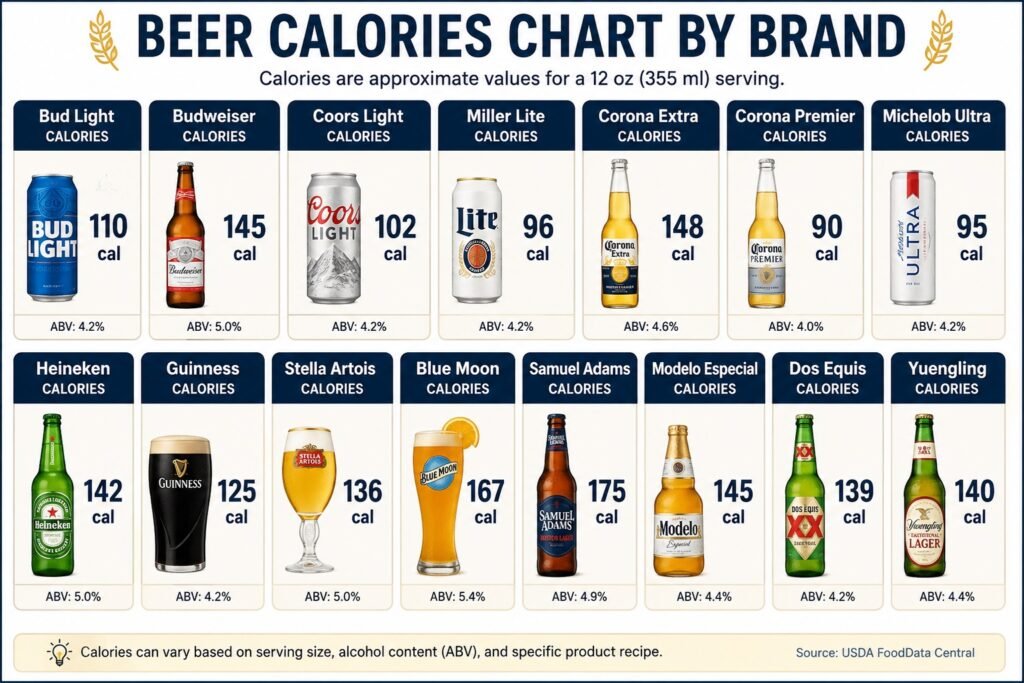
Beer Calories Chart by Brand (Estimated Calories)
The Beer Calories Chart by Brand gives you a quick way to compare the calorie content of some of the most popular beers. While most beers are served in a standard 12-ounce (355 mL) serving, the number of calories can vary based on the alcohol content (ABV), carbohydrates, and brewing process.
- Light beers, such as Michelob Ultra, Corona Premier, and Miller Lite, generally contain fewer calories, making them popular choices for people watching their calorie intake.
- Regular lagers like Budweiser, Heineken, Modelo Especial, and Yuengling usually have moderate calorie levels.
- Wheat beers and craft beers, such as Blue Moon and Samuel Adams, often contain more calories due to their higher carbohydrate content.
Use this chart to compare different brands, make informed choices, and find a beer that fits your health, fitness, or weight management goals. Remember that calorie values are approximate and may vary slightly between product varieties and serving sizes.
Beer Nutrition Facts
Beer contains more than just calories. It also provides a few nutrients, although the amounts are generally small. The exact nutrition depends on the beer style, ingredients, and alcohol content.
Common Nutrients in Beer
Most beers contain
- calories,
- alcohol,
- carbohydrates,
- protein,
- potassium, and
- sodium.
Beer also provides small amounts of B vitamins, which come from the grains and yeast used during brewing. However, beer should not be considered a major source of vitamins or minerals.
Fat and Cholesterol
Beer naturally contains very little fat and no cholesterol. Most of its calories come from alcohol and carbohydrates rather than fat. Checking the nutrition information for your favorite beer can help you better understand what you’re drinking and make choices that fit your health or fitness goals.
Who Should Use This Beer Calorie Calculator?
Our Beer Calorie Estimator is designed for anyone who wants to better understand the calorie content of beer and make informed drinking choices. It provides quick estimates that can help you manage your daily calorie intake and compare different types of beer.
This calculator is useful for:
- Weight loss programs
- Fitness tracking
- Calorie counting
- Low-carb diets
- Nutrition planning
- Personal trainers
- Dietitians
- Health-conscious adults
Whether you’re trying to lose weight, maintain your current weight, or simply stay aware of what you eat and drink, this tool can help. By knowing the calories in your favorite beer, you can make better decisions that fit your health, fitness, or nutrition goals while still enjoying an occasional drink.
Frequently Asked Questions (FAQs)
How many calories are in a 12 oz beer?
Most 12 oz beers contain between 90 and 220 calories, depending on the alcohol content (ABV), carbohydrates, and beer style. Light beers are usually lower in calories, while strong craft beers often contain more.
Does higher ABV mean more calories?
Yes. A higher alcohol by volume (ABV) generally means more calories because alcohol contains about 7 calories per gram. Beers with a higher ABV usually have a higher calorie count.
Which beer has the fewest calories?
Light beers and many non-alcoholic beers typically have the lowest calorie content. Some light beers contain fewer than 100 calories per 12-ounce serving.
Are craft beers higher in calories?
Many craft beers are higher in calories because they often contain more alcohol, carbohydrates, and richer ingredients than standard lagers or light beers.
Does beer contain fat?
No. Beer contains virtually no fat and no cholesterol. Most of its calories come from alcohol and carbohydrates.
Can this calculator estimate calories for any beer?
Yes. By entering the serving size, alcohol percentage (ABV), and carbohydrate information (when available), the calculator provides a close estimate of the total calories in most beers.
How are beer calories calculated?
Beer calories are estimated using the alcohol content, serving size, and carbohydrate content. Since alcohol and carbohydrates both provide calories, these values are used to calculate an estimated total.
Which type of beer has the most calories?
Imperial IPAs, stouts, porters, barleywines, and other high-ABV beers usually contain the most calories because they have more alcohol and residual carbohydrates.
Do carbohydrates increase the calories in beer?
Yes. Carbohydrates contribute about 4 calories per gram. Beers with higher carbohydrate content generally contain more calories than low-carb beers.
Can I drink beer while trying to lose weight?
Yes, but moderation is important. Choosing lower-calorie beers, watching portion sizes, and staying within your daily calorie goal can help you enjoy beer while working toward your weight-loss goals.
Are non-alcoholic beers lower in calories?
Most non-alcoholic beers contain fewer calories than regular beers because they have little or no alcohol. However, calorie content varies by brand, so it's always a good idea to check the nutrition label.
Why do beer calories vary between brands?
Beer calories vary because each brand uses different ingredients, brewing methods, alcohol levels, and carbohydrate content. Even beers of the same style can have different calorie amounts.
References
-
MedlinePlus. Calorie Count – Alcoholic Beverages.
U.S. National Library of Medicine. Reviewed May 14, 2024. -
National Institute on Alcohol Abuse and Alcoholism (NIAAA). The Basics: Defining How Much Alcohol Is Too Much.
National Institutes of Health (NIH). Standard drink sizes and alcohol content. -
Centers for Disease Control and Prevention (CDC). Alcohol Use and Your Health.
Evidence-based guidance on alcohol use, health risks, and moderation. -
Harvard T.H. Chan School of Public Health. The Nutrition Source: Alcohol.
Research on alcohol, calories, weight management, and nutrition. -
MedlinePlus. Alcohol.
Consumer health information on alcohol, standard drink sizes, and health effects from the U.S. National Library of Medicine.