Kayexalate Dosing Calculator
Kayexalate Dosing Calculator
Recommended Dosage
Note: This calculator provides estimated dosing recommendations for Kayexalate. Always consult with a healthcare provider for definitive treatment decisions. Typical dosing ranges:
- Oral: 15-60 g daily in divided doses (1-4 times daily)
- Rectal: 30-50 g every 6 hours as needed

Kayexalate Brand Name
Brand Name: Kayexalate®
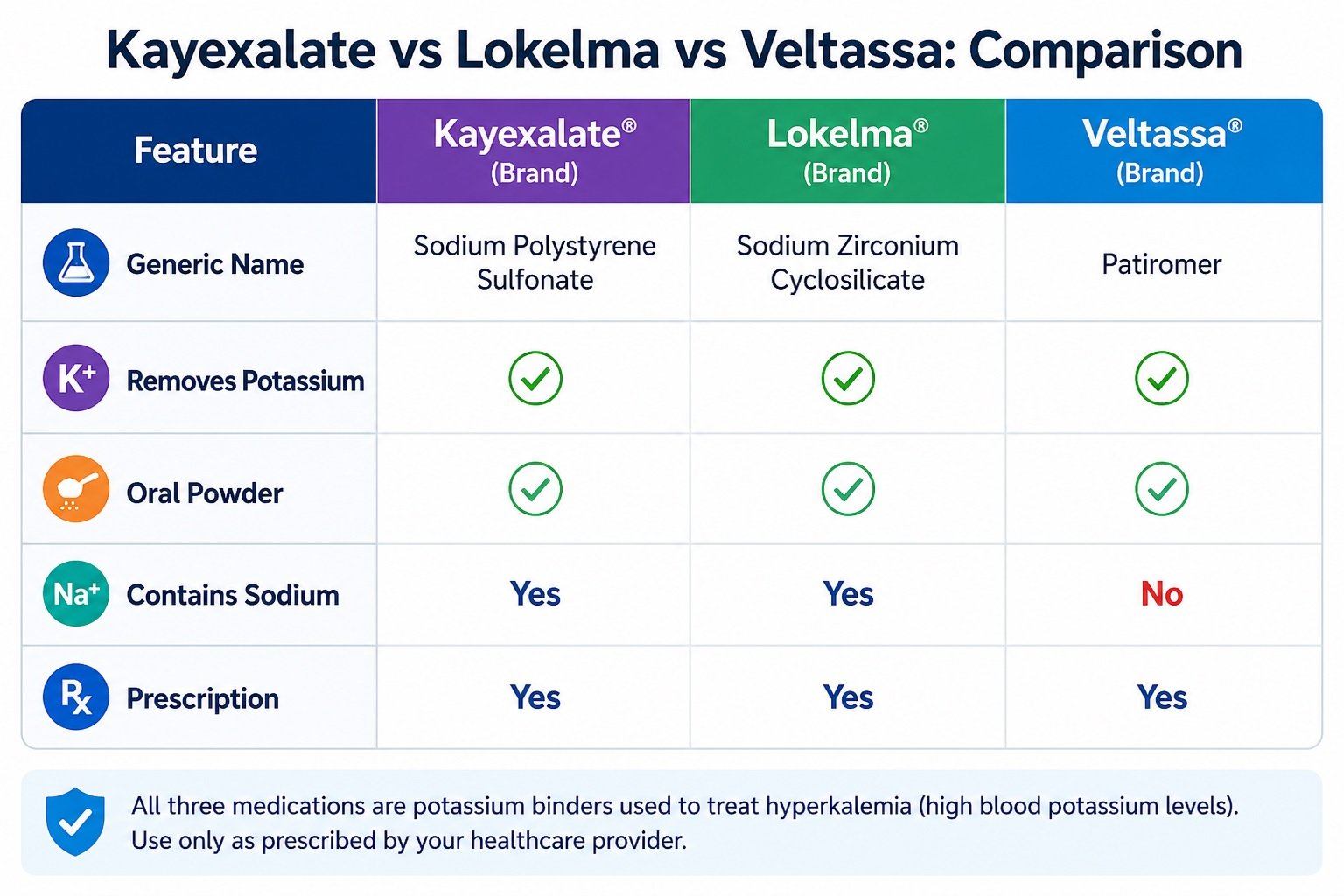
Generic Name: Sodium Polystyrene Sulfonate
Drug Class: Potassium-Binding Cation Exchange Resin
Primary Use: Treatment of Hyperkalemia (High Blood Potassium Levels)
Kayexalate Dosage Guide Based on Serum Potassium Levels
Here is a general guideline comparing serum potassium levels and typical sodium polystyrene sulfonate dosages, as used in clinical settings:
| Serum Potassium (mEq/L) | Typical Dose | Route |
| 5.1 – 5.4 | Usually not required | — |
| 5.5 – 5.9 | 15 grams | Oral |
| 6.0 – 6.4 | 30 grams | Oral or Rectal |
| 6.5 – 6.9 | 45 grams | Oral or Rectal |
| ≥ 7.0 | 30–60 grams | Rectal preferred |
Dosing and Calculation
The dosage calculation is based on serum potassium levels and patient weight, with adjustments for the route of administration (oral vs. rectal). Here’s how it works:
1. Determine Hyperkalemia Severity
First, the calculator classifies the patient’s potassium level:
- Mild hyperkalemia: K⁺ <5.5 mEq/L
- Moderate hyperkalemia: K⁺ 5.5–6.4 mEq/L
- Severe hyperkalemia: K⁺ ≥6.5 mEq/L
2. Weight-Based Dosing (Oral Route)
For oral administration, Kayexalate dosing is weight-based (g/kg/day), with maximum daily limits:
| Potassium Level | Dosing Guidelines | Example Calculation (70 kg Patient) |
|---|---|---|
| Severe (≥6.5 mEq/L) | 1–1.5 g/kg/day (max 60 g/day) | 70 kg × 1.2 g/kg = **84 g/day → Capped at 60 g/day** (15 g every 6 hrs) |
| Moderate (5.5–6.4 mEq/L) | 0.5–1 g/kg/day (max 40 g/day) | 70 kg × 0.8 g/kg = **56 g/day → Capped at 40 g/day** (10 g every 6 hrs) |
| Mild (<5.5 mEq/L) | 0.3 g/kg/day (max 15 g/day) | 70 kg × 0.3 g/kg = **21 g/day → Capped at 15 g/day** (single daily dose) |
3. Fixed Dosing (Rectal Route)
For rectal administration, fixed doses are used (not weight-based):| Potassium Level | Dosing Guidelines | Total Daily Dose |
|---|---|---|
| Severe (≥6.5 mEq/L) | 50 g every 6 hrs | 200 g/day |
| Moderate (5.5–6.4 mEq/L) | 40 g every 6 hrs | 160 g/day |
| Mild (<5.5 mEq/L) | 30 g every 6 hrs (PRN) | 120 g/day (if needed) |
Important Clinical Notes:
- Onset: Oral Kayexalate starts working in ~1–2 hours; rectal works faster.
- Monitoring: Serum potassium levels must be monitored every few hours in severe cases.
- Maximum daily dose: Typically 60–90 grams/day, but can vary.
- Black Box Warning: Risk of intestinal necrosis, especially when used with sorbitol or in patients with GI issues.
Frequently Asked Questions (FAQs) About Kayexalate (Sodium Polystyrene Sulfonate)
Can you mix Kayexalate with juice?
Yes. Kayexalate powder can usually be mixed with a small amount of water or certain juices to make it easier to swallow. However, always follow your healthcare provider’s instructions and avoid mixing it with liquids unless recommended in the product directions.
Can Kayexalate be given IV?
No. Kayexalate should never be given intravenously (IV). It is intended for oral or rectal administration only. Giving Kayexalate by IV is unsafe and is not an approved route of administration.
Can Kayexalate be given rectally?
Yes. Kayexalate can be administered as a rectal enema when a patient cannot take it by mouth or when oral administration is not appropriate. Rectal administration should only be performed under medical supervision.
What is the generic name of Kayexalate?
The generic name of Kayexalate is sodium polystyrene sulfonate. It is a potassium-binding resin used to help lower high potassium levels (hyperkalemia).
What are the common side effects of Kayexalate?
Common side effects include constipation, diarrhea, nausea, vomiting, stomach discomfort, and loss of appetite. Serious side effects are rare but may include intestinal injury or electrolyte imbalances. Contact your healthcare provider if severe symptoms occur.
Can Kayexalate cause hypokalemia?
Yes. Kayexalate can lower potassium levels too much, leading to hypokalemia. Blood potassium levels should be monitored during treatment, especially with repeated doses.
Can Kayexalate be given daily?
It can be prescribed daily in certain situations, but only under the supervision of a healthcare provider. Frequent use requires regular monitoring of potassium and other electrolytes.
What are alternatives to Kayexalate?
Common alternatives include Lokelma (sodium zirconium cyclosilicate) and Veltassa (patiromer). The best option depends on the patient’s potassium level, medical condition, and how quickly potassium needs to be lowered.
Can you mix Kayexalate with food?
Kayexalate may be mixed with certain soft foods if recommended by your healthcare provider or pharmacist. Always follow the preparation instructions provided with the medication.
Can you give Kayexalate and Lokelma together?
Kayexalate and Lokelma are generally not used together because both lower potassium levels. Using both may increase the risk of hypokalemia unless specifically directed by a healthcare provider.
Does Kayexalate cause diarrhea?
Yes. Diarrhea is a possible side effect of Kayexalate, although constipation is also common. The effect varies from person to person.
Does Kayexalate lower potassium?
Yes. Kayexalate removes excess potassium from the body by exchanging sodium for potassium in the intestines. The potassium is then eliminated in the stool, helping reduce blood potassium levels.
Does Kayexalate increase sodium levels?
Yes. Since Kayexalate exchanges sodium for potassium, it can increase sodium intake. Patients with heart failure, kidney disease, or high blood pressure should use it cautiously and under medical supervision.
Does Kayexalate cause constipation?
Yes. Constipation is one of the most common side effects of Kayexalate. Drinking adequate fluids and following your healthcare provider’s recommendations may help reduce this risk.
How does Kayexalate work?
Kayexalate works by binding potassium in the large intestine and exchanging it for sodium. The bound potassium is removed from the body through the stool, helping lower high blood potassium levels.
How do you take Kayexalate?
Take Kayexalate exactly as prescribed by your healthcare provider. It may be taken by mouth as a suspension or administered rectally. Shake the mixture well before use, follow the prescribed dose, and attend all recommended blood tests to monitor potassium levels.
References
- National Library of Medicine. DailyMed: Sodium Polystyrene Sulfonate for Suspension.
https://dailymed.nlm.nih.gov/dailymed/drugInfo.cfm?setid=12d48dcf-07bd-4b06-bd6c-7543f1be8357 - National Center for Biotechnology Information (NCBI). Sodium Polystyrene Sulfonate. StatPearls Publishing.
https://www.ncbi.nlm.nih.gov/books/NBK559206/ - U.S. Food and Drug Administration (FDA). Drug Safety Communication: Sodium Polystyrene Sulfonate (Kayexalate).
https://www.accessdata.fda.gov/drugsatfda_docs/ - National Kidney Foundation (NKF). Hyperkalemia (High Potassium).
https://www.kidney.org/ - University of Utah Health. Sodium Polystyrene Sulfonate (Kayexalate) Should Be Dosed Separately From Other Oral Medications.
https://pharmacyservices.utah.edu/alerts/2017/12/sodium-polystyrene-sulfonate-kayexalate-should-be-dosed-separately-other-oral