Keto Macro Calculator for Weight Loss, Muscle Gain & Maintenance
Personalized Keto Macro Calculator
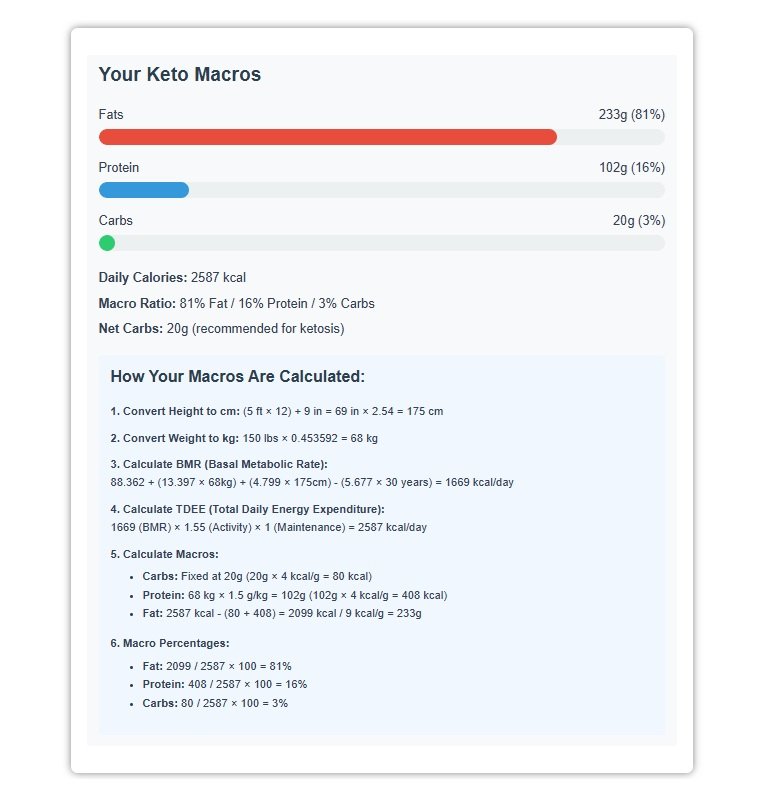
Your Keto Macros
Daily Calories: 0 kcal
Macro Ratio: 0% Fat / 0% Protein / 0% Carbs
Net Carbs: 20g (recommended for ketosis)
How Your Macros Are Calculated:
Note: This calculator provides estimates based on standard keto diet ratios (70-75% fat, 20-25% protein, 5-10% carbs). Individual needs may vary. Consult a healthcare professional before starting any diet.
How to use Keto Calculator
1. Enter Your Personal Details:
- Gender: Select your biological sex (Male or Female).
- Age: Enter your age in years (18-100).
- Height:
- Enter your height in feet (e.g., 5) and inches (e.g., 9).
- The calculator automatically converts this to centimeters for the formula.
- Weight:
- Enter your weight.
- Select the unit (kg or lbs).
2. Select Your Activity Level:
Choose the option that best describes your weekly physical activity:
- Sedentary (little or no exercise)
- Lightly active (light exercise 1-3 days/week)
- Moderately active (moderate exercise 3-5 days/week)
- Very active (hard exercise 6-7 days/week)
- Extra active (very hard exercise & physical job)
3. Choose Your Keto Goal:
- Weight Loss Options:
- 5%, 10%, 15%, or 20% deficit (higher % = more aggressive calorie reduction)
- Maintenance:
- Keeps calories at your calculated TDEE (no deficit or surplus).
- Muscle Gain Options:
- 5%, 10%, 15%, or 20% surplus (higher % = more calories for muscle growth).
4. Click “Calculate Macros”
The calculator will process your inputs and display:
- Daily calorie needs (based on your TDEE and goal).
- Macronutrient breakdown (grams and % of fats, protein, carbs).
- Net carbs (fixed at 20g for ketosis).
- Horizontal bar graphs showing fat, protein, and carb ratios.
What Is a Keto Macro Calculator?
A Keto Macro Calculator is a specialized tool designed to help individuals following a ketogenic (keto) diet determine their daily macronutrient needs which includes, fats, proteins, and carbohydrates.
Unlike general macro calculators, it is tailored to the low-carb, high-fat principles of the keto lifestyle.
Calculate Keto Macros
- BMR (Basal Metabolic Rate) – how many calories your body needs at rest.
- TDEE (Total Daily Energy Expenditure) – how many calories you burn in a day based on activity.
- Calorie target – daily intake recommendation depending on your goal.
- Macro distribution – the breakdown of how much fat, protein, and carbohydrates you should eat each day to stay in ketosis.
How does Keto Calculator helps you reach your goals?
The keto diet requires precise macro tracking to ensure the body enters and remains in ketosis, a metabolic state where fat becomes the primary fuel source instead of carbohydrates.
Here’s how the calculator supports different goals:
- Weight Loss: Sets a calorie deficit while maintaining enough fat and protein to prevent muscle loss.
- Muscle Gain: Increases calories and protein within keto limits to support muscle repair and growth.
- Maintenance: Provides balanced macros to sustain current weight while keeping the body in ketosis.
By tailoring nutrition to your individual needs, a keto macro calculator eliminates guesswork, making your diet more efficient, sustainable, and science-backed.
What is BMR (Basal Metabolic Rate)?
Basal Metabolic Rate (BMR) is the number of calories your body burns at rest to maintain essential life functions like breathing, circulation, cell production, and body temperature regulation. Think of it as the minimum energy required to keep you alive, even if you stayed in bed all day without moving.
Knowing your BMR is crucial because it serves as the baseline for determining how many total calories your body actually needs each day. It varies based on age, sex, weight, and height.
What is TDEE (Total Daily Energy Expenditure)?
Total Daily Energy Expenditure (TDEE) is the total number of calories you burn each day, including all activities from walking, working, and exercising, to simply digesting food.
TDEE factors in:
- Your BMR
- Physical activity level (sedentary, light, moderate, active, or very active)
- Thermic effect of food (energy spent digesting and processing food)
- Non-exercise activity thermogenesis (NEAT) (like fidgeting, house chores, etc.)
TDEE Formula:
TDEE = BMR × Activity Factor
This helps determine how many calories you need to maintain, gain, or lose weight depending on your goals.
BMR Calculation Distribution on a Keto Diet
Our calculator uses the Mifflin-St Jeor Equation, which is one of the most accurate formulas to estimate BMR.
- For Men: BMR=(10×weight in kg)+(6.25×height in cm)−(5×age)+5
- For Women: BMR=(10×weight in kg)+(6.25×height in cm)−(5×age)−161
Once BMR is calculated, it’s multiplied by an activity factor to get TDEE:
| Activity Level | Description | Multiplier |
| Sedentary | Little or no exercise, mostly sitting (e.g., office job) | 1.2 |
| Lightly active | Light exercise/sports 1–3 days/week, light daily movement (e.g., walking) | 1.375 |
| Moderately active | Moderate exercise/sports 3–5 days/week | 1.55 |
| Very active | Hard exercise/sports 6–7 days/week | 1.725 |
| Extra active | Very hard exercise & physical job or twice-a-day training (e.g., athlete, construction worker) | 1.9 |
Understanding your BMR and TDEE allows your keto macro calculator to:
- Personalize daily calorie targets
- Tailor fat, protein, and carb intake
- Support weight loss, maintenance, or muscle gain goals more effectively
Macronutrient Distribution on a Keto Diet
What Are Macronutrients?
Macronutrients are the main nutrients your body needs in large amounts to stay healthy and give you energy. They include carbohydrates, proteins, and fats. Each one plays a special role-carbs give quick energy, protein builds muscles, and fat helps with energy storage and hormone balance.
A ketogenic diet strategically alters the balance of these macros to shift the body’s metabolism into a state called ketosis, where fat becomes the primary fuel source instead of glucose (sugar).
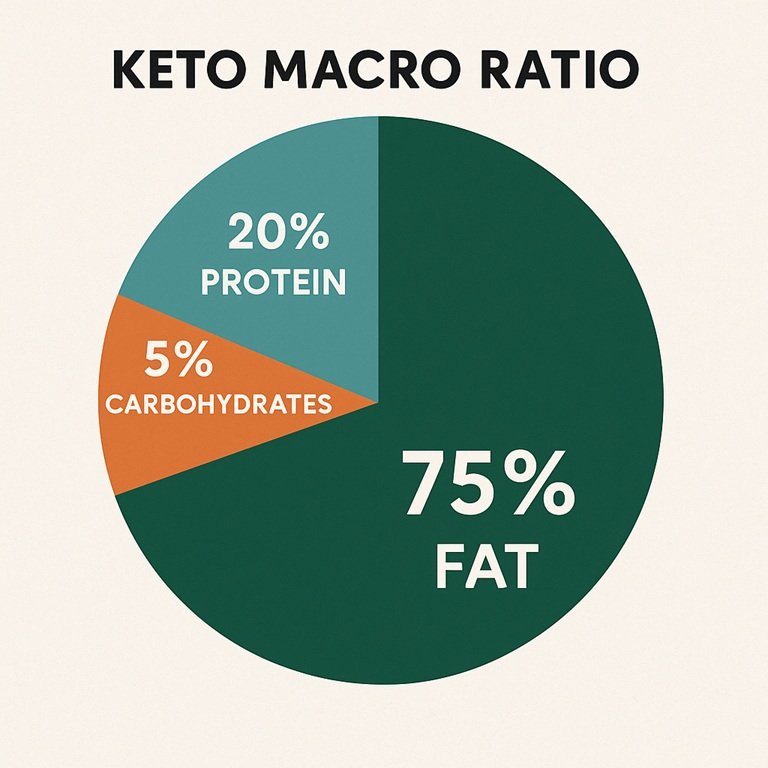
Typical Keto Macro Ratios
To achieve and maintain ketosis, the standard keto diet recommends the following daily macronutrient distribution:
Fat: 75–80% of total daily calories
Protein: 10–15% of total daily calories
Carbohydrates: 3 to 5% of total daily calories (usually 20–50g net carbs per day)
Keto Macros Macronutrients
Keto macros refer to the three main macronutrients; fat, protein, and carbohydrates. They are carefully balanced to support ketosis, the fat-burning state central to the ketogenic diet. Here’s how each component works:
1. Fat – 75% to 80% of Total Daily Calories
- Primary energy source on the keto diet.
- Fuels the body and supports ketone production.
- Promotes satiety and regulates hormones.
- Healthy fat sources: avocado, olive oil, coconut oil, butter, nuts, seeds, ghee, fatty fish.
1 gram of fat = 9 calories
2. Protein – 15% to 20% of Total Daily Calories
- Supports muscle maintenance, tissue repair, and immune function.
- Must be consumed in moderate amounts to avoid excess protein converting to glucose (gluconeogenesis), which can disrupt ketosis.
- Best protein sources: eggs, poultry, fish, grass-fed beef, tofu, cheese, protein powders (low-carb).
1 gram of protein = 4 calories
3. Carbohydrates – 5% or Less of Total Daily Calories
- Kept very low (20–50g net carbs/day) to force the body into using fat for energy.
- Only non-starchy vegetables, low-sugar fruits (berries), and nuts are recommended.
- Focus on net carbs (total carbs – fiber – sugar alcohols).
1 gram of carbohydrates = 4 calories
Keto Macros in Action (Example for 2,000 Calories/day)
| Macronutrient | % of Calories | Calories | Grams |
| Fat | 75% | 1,500 | 167 g |
| Protein | 20% | 400 | 100 g |
| Carbs | 5% | 100 | 25 g |
How Keto Diet Promote Fat Burning?
By reducing carbohydrate intake to a minimum, your insulin levels drop and glycogen stores deplete. This forces your body to switch from burning sugar to burning stored fat for energy.
The liver begins converting fats into ketones, which become the body’s primary energy source in a ketogenic state.
Result: Enhanced fat loss, reduced hunger, and more stable energy levels throughout the day — all key benefits that drive keto’s popularity.
Frequently Asked Questions (FAQs)
1. How do you calculate a keto diet?
A keto diet is calculated by determining your daily calorie needs and dividing those calories into carbohydrates, protein, and fat. Most ketogenic diets recommend 5–10% of calories from carbs, 20–30% from protein, and 60–75% from healthy fats. A Keto Macro Calculator simplifies this process by providing personalized macro targets.
2. What is a Keto Macro Calculator?
A Keto Macro Calculator estimates the ideal daily intake of carbohydrates, protein, fat, and calories based on your age, gender, height, weight, activity level, and health goals. It helps create a personalized ketogenic meal plan for weight loss, maintenance, or muscle gain.
3. Does the keto diet work for weight loss?
Yes. Many people lose weight on a ketogenic diet because reducing carbohydrate intake encourages the body to burn stored fat for energy, a metabolic state called ketosis. Success depends on maintaining a calorie deficit and following the diet consistently.
4. What are the benefits of a keto diet?
A ketogenic diet may support weight loss, reduce appetite, improve blood sugar control, increase fat burning, enhance mental focus, and help maintain steady energy levels. Some people also experience improved triglyceride and HDL cholesterol levels.
5. What are the disadvantages or cons of a keto diet?
Some people experience temporary side effects such as the "keto flu," fatigue, headaches, constipation, or electrolyte imbalances during the first few weeks. Long-term success requires careful meal planning to ensure adequate nutrient intake.
6. How do you calculate the ketogenic diet ratio?
The ketogenic diet ratio compares grams of fat to the combined grams of protein and carbohydrates. A classic ketogenic diet often uses a 4:1 or 3:1 ratio, while many adults follow a more flexible macro-based ketogenic plan that emphasizes net carbohydrate limits.
7. How many carbs can you eat on a keto diet?
Most ketogenic diets limit net carbohydrates to 20–50 grams per day. Staying within this range helps many people achieve and maintain nutritional ketosis, although individual carbohydrate tolerance varies.
8. What are the ideal keto macros for beginners?
A common starting point for beginners is approximately 70% of calories from fat, 25% from protein, and 5% from carbohydrates. A Keto Macro Calculator provides personalized recommendations based on your body composition and activity level.
9. How much protein should I eat on a ketogenic diet?
Protein intake depends on your weight, age, activity level, and fitness goals. Most adults consume moderate amounts of protein to help preserve muscle mass while maintaining ketosis. A Keto Macro Calculator estimates the appropriate daily protein intake for your needs.
10. Why should I use a Keto Macro Calculator?
A Keto Macro Calculator removes the guesswork from ketogenic meal planning by calculating your daily calories, fat, protein, carbohydrates, and keto ratio. It helps improve accuracy, supports weight management goals, and makes it easier to stay in ketosis.
References
- Harvard T.H. Chan School of Public Health. Diet Review: Ketogenic Diet for Weight Loss. Available at: https://nutritionsource.hsph.harvard.edu/healthy-weight/diet-reviews/ketogenic-diet/ . Accessed July 2026.
- University of California, Davis. The Ketogenic Diet. Available at: https://nutrition.ucdavis.edu/outreach/nutr-health-info-sheets/pro-ketogenic-diet . Accessed July 2026.
- The Charlie Foundation. What Is a Ketogenic Diet? Keto Diet Facts. Available at: https://charliefoundation.org/diet-plans/ . Accessed July 2026.
- Boston Children's Hospital. Ketogenic Diet. Available at: https://www.childrenshospital.org/conditions-treatments/ketogenic-diet . Accessed July 2026.