Decimal to Fraction Calculator (Mixed, Proper & Improper Fractions)
Fraction & Decimal Converter
Live, instant conversion with step-by-step solutions
Decimal to Fraction Calculator – Quick & Easy Conversion
Convert Any Decimal to Fraction Instantly
A decimal to fraction calculator makes math simple. Instead of struggling with manual calculations, you can convert decimal to fraction in seconds. Just type your decimal number, and the tool shows the exact fraction instantly.
Handles All Decimal Types
Whether you have a terminating decimal like 0.75 or a repeating decimal like 0.333…, the calculator handles both perfectly. It recognizes patterns and converts them accurately without any guesswork.
Automatic Simplification
You don’t need to worry about reducing fractions. The calculator simplifies everything automatically, giving you the decimal as a fraction in its lowest terms. No extra steps required.
Mixed & Improper Fractions
The tool works as both a fraction converter and a mixed fraction calculator. It can show results as proper fractions, improper fractions, or mixed numbers. The improper fraction converter option is great for advanced math needs.
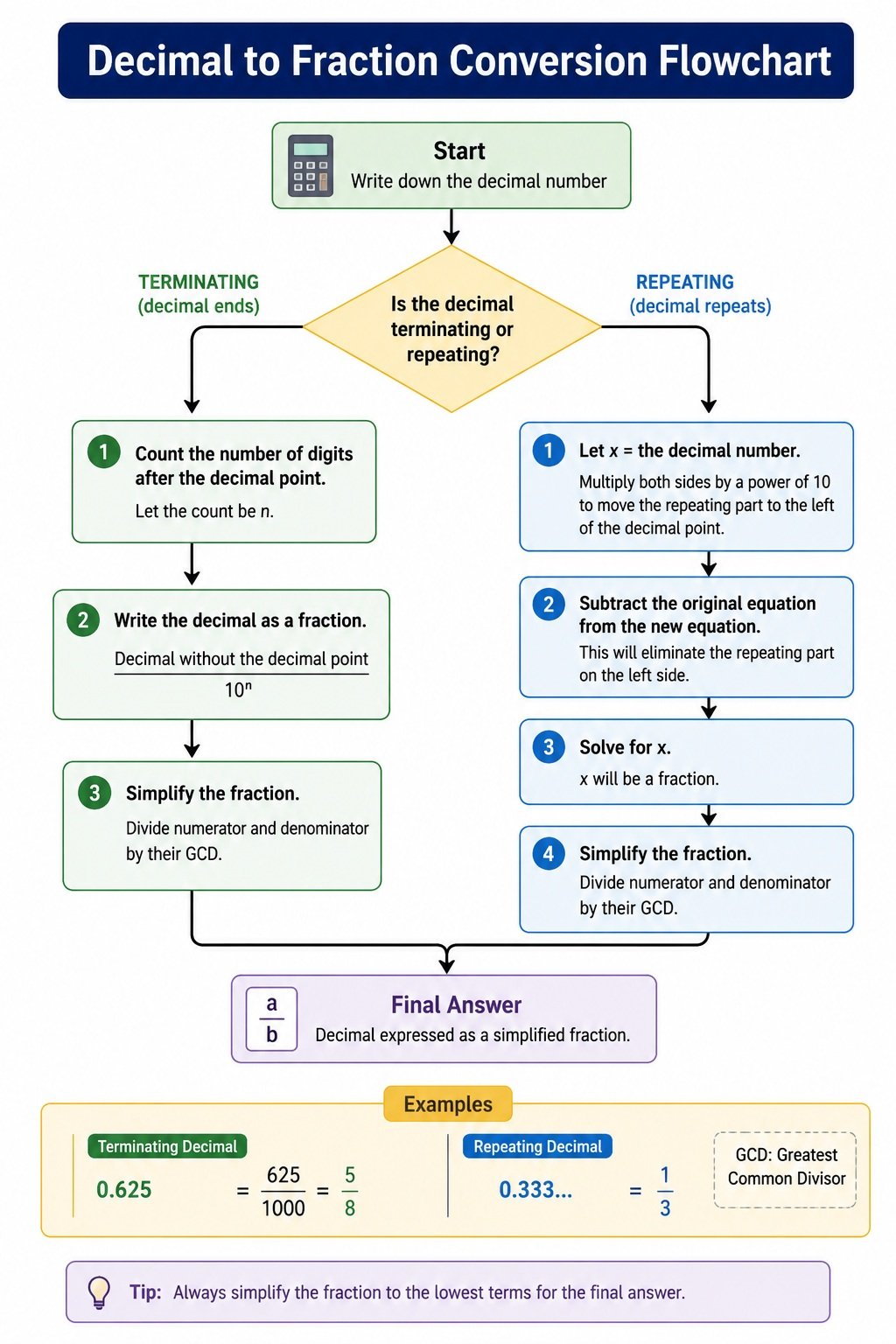
Decimal to Fraction Conversion Formula
Formula
Where n = number of digits after the decimal point. Simplify the resulting fraction by dividing the numerator and denominator by their Greatest Common Factor (GCF).
Example:
Convert a Decimal to a Fraction
- Start with the decimal: 0.375
- Write the decimal as a fraction: 375 / 1000
Simplify by dividing the numerator and denominator by their Greatest Common Factor (125):
- 375 ÷ 125 = 3
- 1000 ÷ 125 = 8
Final Answer: 0.375 = 3/8
Fraction to Decimal Conversion Formula
Simple Fraction
Mixed Fraction
Divide the numerator by the denominator. For mixed fractions, add the whole number to the quotient.
Example 1:
Simple Fraction to Decimal
- Start with the fraction: 3/8
- Divide the numerator by the denominator: 3 ÷ 8 = 0.375
Final Answer: 3/8 = 0.375
Example 2:
Mixed Fraction to Decimal
- Start with the mixed fraction: 2 3/4
- Convert the fractional part to a decimal: 3 ÷ 4 = 0.75
- Add the whole number: 2 + 0.75 = 2.75
Final Answer: 2 3/4 = 2.75
Decimal to Fraction Conversion Chart
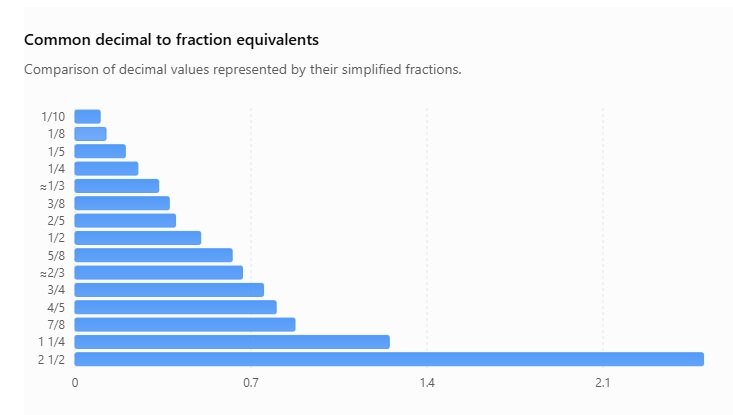
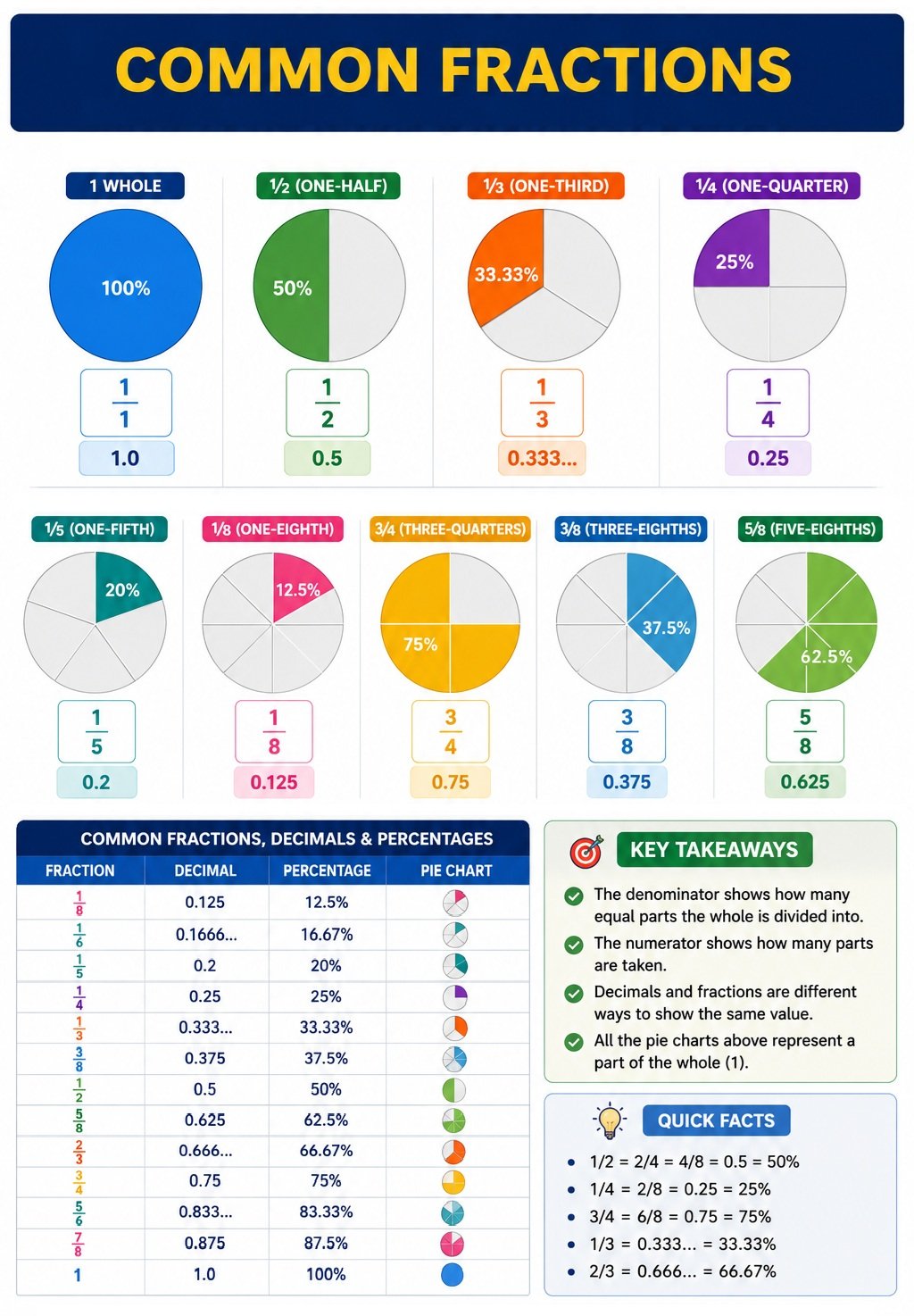
Use this Decimal to Fraction Conversion Chart to quickly convert common decimals into fractions and their simplest forms. This reference table is ideal for students, teachers, engineers, carpenters, and anyone solving math problems. It includes repeating decimals, mixed numbers, and simplified fractions, making decimal-to-fraction conversions fast, accurate, and easy to understand.
| Decimal | Fraction |
Simplified Fraction
|
| 0.1 | 1/10 | 1/10 |
| 0.125 | 125/1000 | 1/8 |
| 0.2 | 2/10 | 1/5 |
| 0.25 | 25/100 | 1/4 |
| 0.333 | 333/1000 | ≈ 1/3 |
| 0.375 | 375/1000 | 3/8 |
| 0.4 | 4/10 | 2/5 |
| 0.5 | 5/10 | 1/2 |
| 0.625 | 625/1000 | 5/8 |
| 0.666 | 666/1000 | ≈ 2/3 |
| 0.75 | 75/100 | 3/4 |
| 0.8 | 8/10 | 4/5 |
| 0.875 | 875/1000 | 7/8 |
| 1.25 | 125/100 | 1 1/4 |
| 2.5 | 25/10 | 2 1/2 |
Decimal vs Fraction Comparison Table
| Feature | Decimal | Fraction |
| Definition | Represents part of a whole using a decimal point. | Represents part of a whole as a ratio of two integers. |
| Format | 0.25, 1.5, 2.75 | 1/4, 3/2, 2 3/4 |
| Components | Whole number and decimal digits | Numerator and denominator |
| Exact Value | May be exact or rounded (e.g., 0.333) | Can represent exact values (e.g., 1/3) |
| Simplification | Cannot be simplified | Can often be reduced to lowest terms |
| Arithmetic | Easy for calculators and computers | Preferred for exact mathematical calculations |
| Measurement | Common in science, engineering, and finance | Common in construction, cooking, and woodworking |
| Mental Math | Easier for estimation and percentages | Easier for comparing parts of a whole |
| Precision | May lose precision due to rounding | Maintains exact precision when not simplified |
| Conversion | Can be converted into fractions | Can be converted into decimals by division |
Quick Comparison
| Decimal | Equivalent Fraction |
| 0.1 | 1/10 |
| 0.25 | 1/4 |
| 0.5 | 1/2 |
| 0.75 | 3/4 |
| 1.25 | 1 1/4 |
| 2.5 | 2 1/2 |
Frequently Asked Questions (FAQs)
1. How do you convert a decimal to a fraction?
Write the decimal as a fraction by placing it over 10, 100, 1,000, or another power of 10 depending on the number of decimal places. Then simplify the fraction by dividing the numerator and denominator by their greatest common factor (GCF).
2. What is 0.75 as a fraction?
0.75 equals 75/100. After simplifying by dividing both numbers by 25, the fraction becomes 3/4.
3. What is 0.5 as a fraction?
0.5 is written as 5/10 and simplifies to 1/2 after dividing both the numerator and denominator by 5.
4. How do you convert a fraction to a decimal?
Divide the numerator by the denominator using long division or a calculator. The result is the decimal equivalent of the fraction.
5. What is 3/4 as a decimal?
Divide 3 by 4. The result is 0.75.
6. What is 1/8 as a decimal?
1 divided by 8 equals 0.125.
7. How do you simplify a fraction?
Find the greatest common factor (GCF) of the numerator and denominator, then divide both by that number to obtain the simplest form.
8. Can repeating decimals be converted into fractions?
Yes. Every repeating decimal can be expressed as an exact fraction. For example, 0.333... equals 1/3 and 0.666... equals 2/3.
9. What is the easiest way to convert decimals into fractions?
Count the decimal places, write the number without the decimal point over the appropriate power of ten, and simplify the result using the greatest common factor.
10. Why do some decimals have repeating digits?
Repeating decimals occur when a fraction cannot be expressed as a terminating decimal. The division continues indefinitely with a repeating pattern.
11. What is the difference between a terminating and a repeating decimal?
A terminating decimal has a finite number of digits after the decimal point, while a repeating decimal contains one or more digits that repeat forever.
12. Can improper fractions be converted into decimals?
Yes. Divide the numerator by the denominator. The result may be a terminating decimal, a repeating decimal, or a decimal greater than 1.
13. How do you convert a mixed number into a decimal?
Convert the fractional part into a decimal by dividing the numerator by the denominator, then add the whole number.
14. Why are fractions used instead of decimals?
Fractions often provide exact values without rounding. They are commonly used in mathematics, construction, cooking, engineering, and measurements.
15. What is the fastest way to convert decimals and fractions online?
A Decimal to Fraction Calculator instantly converts terminating and repeating decimals into simplified fractions and also converts fractions or mixed numbers back into decimal form with step-by-step calculations.
References
-
OpenStax Prealgebra 2e – 5.3 Decimals and Fractions
https://openstax.org/books/prealgebra-2e/pages/5-3-decimals-and-fractions -
OpenStax Prealgebra – 5.3 Decimals and Fractions
https://openstax.org/books/prealgebra/pages/5-3-decimals-and-fractions -
OpenStax Elementary Algebra 2e – 1.7 Decimals
https://openstax.org/books/elementary-algebra-2e/pages/1-7-decimals -
CK-12 Foundation – Decimals and Fractions
https://www.ck12.org/arithmetic/decimals-and-fractions/ -
The University of Arizona – Decimal Fractions
https://math.arizona.edu/~calc/