Percentage Calculator – Find Percentages, Percentage Increase, Decrease & More
What is X% of Y?
Find the value that a given percentage represents of a number.
X is what % of Y?
Find what percentage one number is of another.
X is Y% of what?
Find the total when you know a part and its percentage.
Increase %
Find the percentage increase from an initial value to a new value.
Decrease %
Find the percentage decrease from an initial value to a new value.
Percentage Difference
Find the symmetric percentage difference between two values (neither is treated as the "original").
Percentage Change
Find the signed percentage change from an old value to a new value (positive = increase, negative = decrease).
Reverse Percentage
Work backwards from a final value to find the original number before a percentage was applied.
Compound Percentage
Apply the same percentage rate repeatedly over several periods (like compound interest).
Successive Percentage
Apply two percentage changes one after another (e.g. a 20% increase followed by a 10% decrease) and see the net effect.
Discount Calculator
Find the final price after applying a percentage discount.
Sales Tax Calculator
Find the tax amount and total price for a purchase.
Tip Calculator
Find the tip amount and total, optionally split across a group.
Commission Calculator
Find the commission earned on a sale.
Profit Margin Calculator
Find your profit margin — profit as a percentage of the selling price.
Markup Calculator
Find the selling price after applying a markup percentage on top of cost.
VAT Calculator
Find the VAT amount and gross/net price.
Inflation Calculator
Estimate the future price of something today, given an average inflation rate.
Grade Percentage Calculator
Find the percentage score from points earned out of a total.
Error Percentage Calculator
Find the percentage error between a measured (experimental) value and the true (accepted) value.
Percentage Calculator – 20 Essential Tools in One
This all‑in‑one percentage calculator handles seven common percentage scenarios with real‑time results — no clicking, no waiting, no page reloads. Just type and see the answer instantly.
What does this calculator do?
| Mode | What It Calculates | Example |
| X% of Y | Finds a percentage of a number | 25% of 200 = 50 |
| X is what % of Y | What percent one number is of another | 50 is 25% of 200 |
| X is Y% of what | Finds the whole when you know a part and percentage | 50 is 25% of 200 |
| Increase % | Percent increase from old to new value | 100 → 120 = +20% |
| Decrease % | Percent decrease from old to new value | 200 → 150 = -25% |
| % Difference | Percent difference between two values (ignores direction) | 100 vs 80 = 22.22% |
| % Change | General percent change (can be positive or negative) | 50 → 75 = +50% |
| Reverse % | Finds original value after a percentage increase | 120 after 25% increase = 96 |
| Compound % | Compound growth over multiple periods | 1000 at 5% for 3 years = 1157.63 |
| Successive % | Two percentage changes applied one after another | 200 +10% then +5% = 231 |
| Discount | Final price after a discount and amount saved | $80 with 20% off = **$64** (save $16) |
| Sales Tax | Total price including tax and tax amount | $100 + 7.5% tax = **$107.50** (tax $7.50) |
| Tip | Total bill including tip and tip amount | $45 + 15% tip = **$51.75** (tip $6.75) |
| Commission | Commission earned from a sale | $5000 at 5% = **$250** |
| Profit Margin | Profit as a percentage of revenue | $200 revenue, $150 cost = 25% |
| Markup | Markup percentage based on cost | $80 cost, $120 sell = 50% |
| VAT | Total including VAT and VAT amount | $100 + 20% VAT = **$120** (VAT $20) |
| Inflation | Inflation rate between two values | 100 → 110 = 10% |
| Grade % | Percentage score on a test | 85 out of 100 = 85% |
| Error % | Percentage error between true and measured values | True 100, Measured 95 = 5% |
Practical Use Cases
Shopping & Consumer
- Discount – “This $80 jacket is 20% off. What’s the final price?” → $64
- Sales Tax – “How much do I pay for a $100 item with 7.5% tax?” → $107.50
Tip – “What’s a 15% tip on a $45 dinner?” → **$51.75 total**
Education & Study
- Grade % – “I got 85 out of 100. What’s my percentage?” → 85%
- Error % – “My measured value was 95, but the true value is 100. What’s my error?” → 5%
Business & Finance
- Profit Margin – “I made $200 in revenue with $150 in costs. What’s my profit margin?” → 25%
- Markup – “I buy for $80 and sell for $120. What’s my markup?” → 50%
- Commission – “I made $5,000 in sales at 5% commission. How much do I earn?” → $250
- VAT – “What’s the total price including 20% VAT on a $100 item?” → $120
Growth & Analysis
- Increase % – “My followers grew from 100 to 120. What’s the increase?” → +20%
- Compound % – “I invested $1000 at 5% for 3 years. What’s the final amount?” → $1,157.63
- Inflation – “Prices rose from $100 to $110. What’s the inflation rate?” → 10%
Everyday Math
- X% of Y – “What’s 25% of 200?” → 50
- X is what % of Y – “50 is what percent of 200?” → 25%
- X is Y% of what – “50 is 25% of what number?” → 200
- % Difference – “What’s the percentage difference between 100 and 80?” → 22.22%
Who uses Percentage Calculator
- Shoppers: Calculate discounts, sales tax, and tips on the go
- Students: Check homework, learn formulas, practice percentage problems
- Teachers: Demonstrate percentage concepts interactively
- Business Owners: Compute profit margins, markups, commissions, and VAT
- Investors: Calculate returns, compound growth, and inflation
- Analysts: Determine percentage changes, differences, and errors
- Everyone: Quick percentage calculations for everyday life
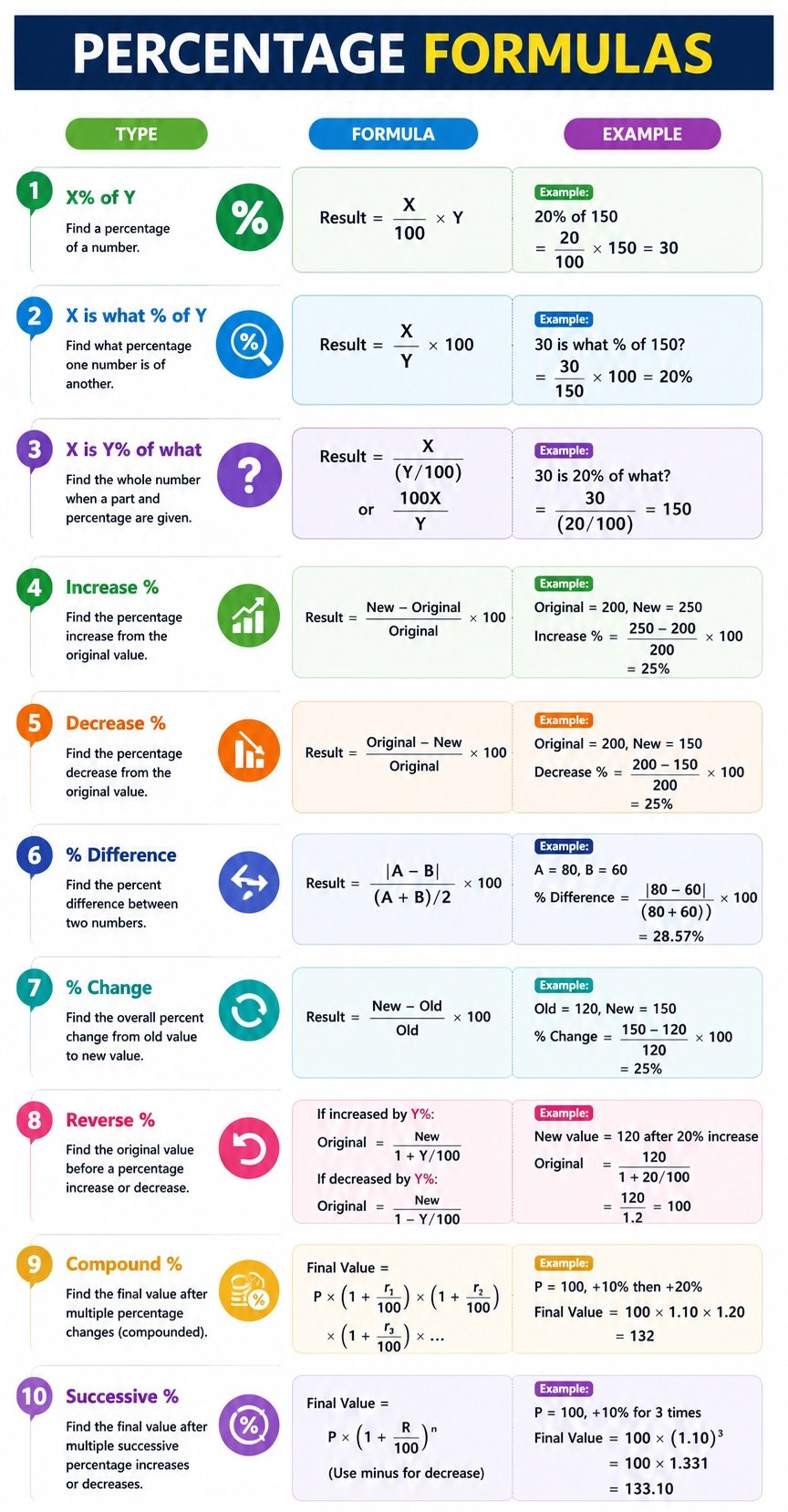
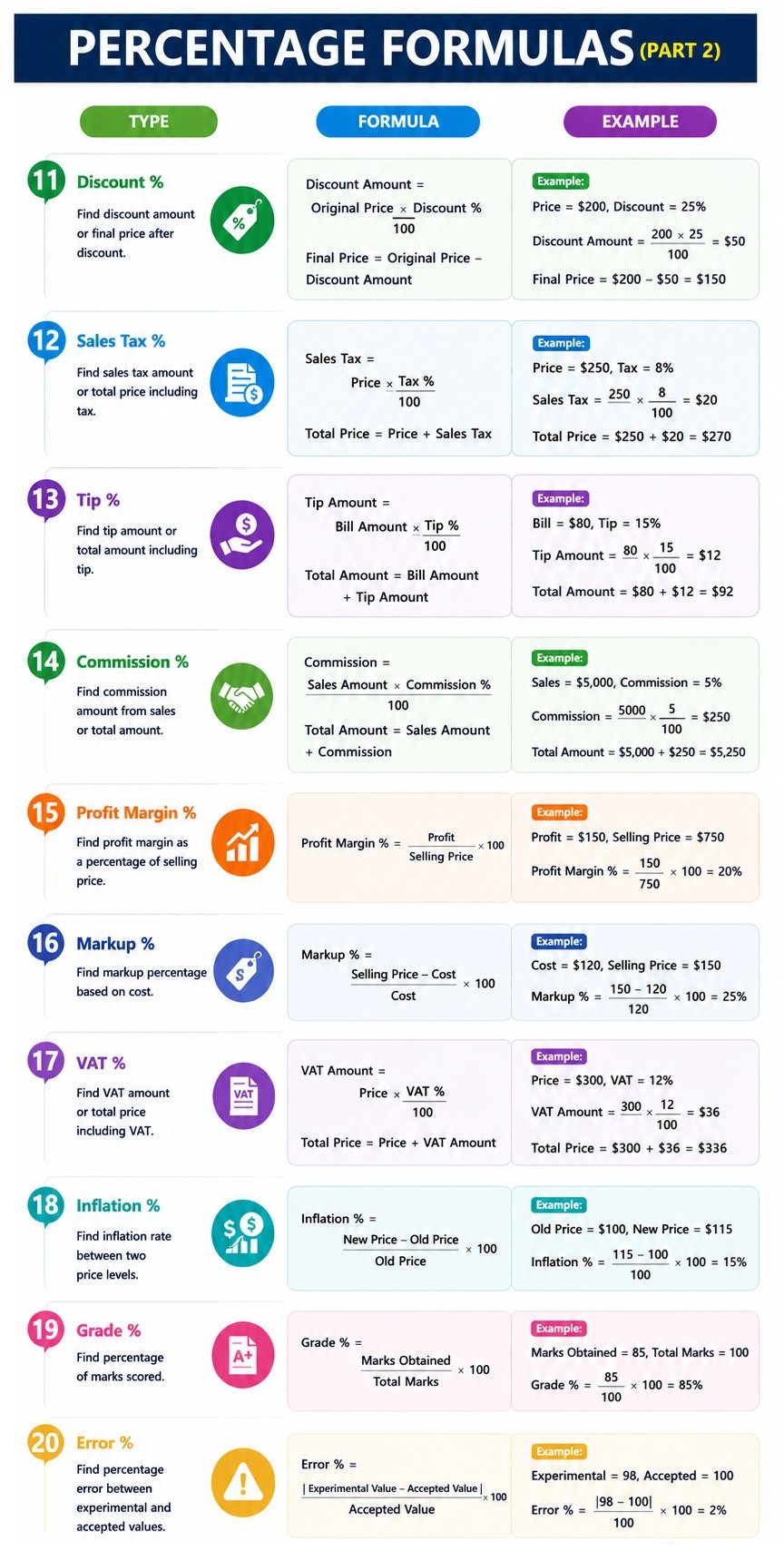
Formula Used in Percentage Calculations
X% of Y
Formula: Result = (X ÷ 100) × Y
Example: What is 25% of 200?
(25 ÷ 100) × 200 = 0.25 × 200 = 50
Use case: Finding a percentage of a number (discounts, tips, tax amounts).
X is what % of Y
Formula: Result = (X ÷ Y) × 100
Example: 50 is what percent of 200?
(50 ÷ 200) × 100 = 0.25 × 100 = 25%
Use case: Determining what proportion one number is of another.
X is Y% of what
Formula: Result = (X ÷ Y) × 100
Example: 50 is 25% of what number?
(50 ÷ 25) × 100 = 2 × 100 = 200
Use case: Finding the original total when you know a part and its percentage.
Increase %
Formula: Result = ((New – Old) ÷ Old) × 100
Example: From 100 to 120, what’s the increase?
((120 – 100) ÷ 100) × 100 = (20 ÷ 100) × 100 = 20%
Use case: Measuring growth or appreciation.
Decrease %
Formula: Result = ((New – Old) ÷ Old) × 100
(Result will be negative for a decrease)
Example: From 200 to 150, what’s the decrease?
((150 – 200) ÷ 200) × 100 = (-50 ÷ 200) × 100 = -25%
Use case: Measuring decline or depreciation.
% Difference
Formula: Result = (|A – B| ÷ ((A + B) ÷ 2)) × 100
Example: Percentage difference between 100 and 80:
(|100 – 80| ÷ ((100 + 80) ÷ 2)) × 100 = (20 ÷ 90) × 100 = 22.22%
Use case: Comparing two values regardless of direction (ignores which is larger).
% Change
Formula: Result = ((New – Old) ÷ Old) × 100
Example: From 50 to 75, what’s the change?
((75 – 50) ÷ 50) × 100 = (25 ÷ 50) × 100 = 50%
Use case: General percentage change (can be positive or negative).
Reverse %
Formula: Result = Final ÷ (1 + Percentage ÷ 100)
Example: 120 is after a 25% increase. What was the original value?
120 ÷ (1 + 25 ÷ 100) = 120 ÷ 1.25 = 96
Use case: Finding the original value before a percentage increase.
Compound %
Formula: Result = Initial × (1 + Rate ÷ 100)^Periods
Example: $1000 at 5% for 3 years:
1000 × (1 + 5 ÷ 100)^3 = 1000 × 1.05^3 = 1000 × 1.157625 = 1157.63
Use case: Calculating compound interest or growth over multiple periods.
Successive %
Formula: Result = Base × (1 + A ÷ 100) × (1 + B ÷ 100)
Example: 200 with +10% then +5%:
200 × (1 + 10 ÷ 100) × (1 + 5 ÷ 100) = 200 × 1.10 × 1.05 = 231
Use case: Applying two percentage changes in sequence.
Discount
Formula:
- Final Price = Price × (1 – Discount% ÷ 100)
- Amount Saved = Price × (Discount% ÷ 100)
Example: $80 with 20% off:
- Final Price = 80 × (1 – 20 ÷ 100) = 80 × 0.80 = 64
- Amount Saved = 80 × (20 ÷ 100) = 80 × 0.20 = 16
Use case: Calculating sale prices and savings.
Sales Tax
Formula:
- Tax Amount = Amount × (Tax% ÷ 100)
- Total = Amount + Tax Amount
Example: $100 with 7.5% tax:
- Tax Amount = 100 × (7.5 ÷ 100) = 100 × 0.075 = 7.50
- Total = 100 + 7.50 = 107.50
Use case: Adding tax to a purchase.
Tip
Formula:
- Tip Amount = Bill × (Tip% ÷ 100)
- Total = Bill + Tip Amount
Example: $45 with 15% tip:
- Tip Amount = 45 × (15 ÷ 100) = 45 × 0.15 = 6.75
- Total = 45 + 6.75 = 51.75
Use case: Calculating gratuity for services.
Commission
Formula: Commission = Sales × (Rate% ÷ 100)
Example: $5000 at 5% commission:
5000 × (5 ÷ 100) = 5000 × 0.05 = 250
Use case: Calculating earnings from sales.
Profit Margin
Formula: Margin = ((Revenue – Cost) ÷ Revenue) × 100
Example: Revenue $200, Cost $150:
((200 – 150) ÷ 200) × 100 = (50 ÷ 200) × 100 = 25%
Use case: Measuring profitability as a percentage of revenue.
Markup
Formula: Markup = ((Sell Price – Cost) ÷ Cost) × 100
Example: Cost $80, Sell Price $120:
((120 – 80) ÷ 80) × 100 = (40 ÷ 80) × 100 = 50%
Use case: Calculating the percentage increase from cost to selling price.
VAT (Value Added Tax)
Formula:
- VAT Amount = Amount × (VAT% ÷ 100)
- Total = Amount + VAT Amount
Example: $100 with 20% VAT:
- VAT Amount = 100 × (20 ÷ 100) = 100 × 0.20 = 20
- Total = 100 + 20 = 120
Use case: Calculating tax on goods and services.
Inflation
Formula: Inflation Rate = ((New – Old) ÷ Old) × 100
Example: From $100 to $110:
((110 – 100) ÷ 100) × 100 = (10 ÷ 100) × 100 = 10%
Use case: Measuring price increases over time.
Grade %
Formula: Grade = (Score ÷ Total) × 100
Example: 85 out of 100:
(85 ÷ 100) × 100 = 0.85 × 100 = 85%
Use case: Calculating test scores and assignments.
Error %
Formula: Error = (|True Value – Measured Value| ÷ True Value) × 100
Example: True = 100, Measured = 95:
(|100 – 95| ÷ 100) × 100 = (5 ÷ 100) × 100 = 5%
Use case: Measuring accuracy in experiments and measurements.
Percentage Cheat Sheet
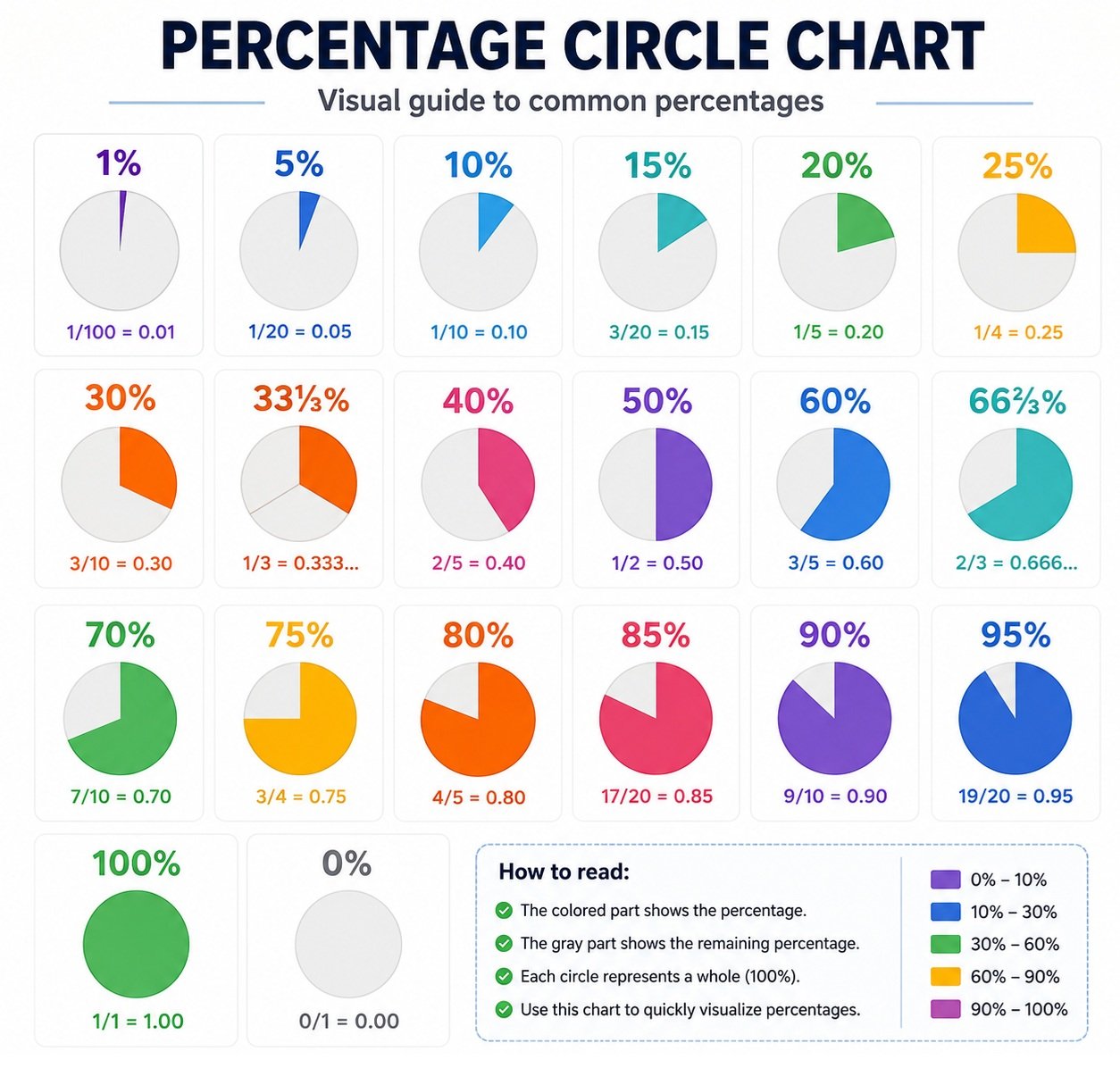
The Percentage Cheat Sheet below provides a quick reference for converting percentages into their decimal and fraction equivalents. Students, teachers, shoppers, business professionals, and anyone working with discounts, grades, taxes, or financial calculations can use this table to perform mental math faster and verify calculator results. Many of these common percentage values appear frequently in everyday calculations, making this chart a convenient reference for school, work, and personal finance.
| Percentage | Decimal | Fraction | Common Use |
| 1% | 0.01 | 1/100 | Interest rates, probability |
| 5% | 0.05 | 1/20 | Small discounts, sales tax |
| 10% | 0.1 | 1/10 | Tips, discounts |
| 15% | 0.15 | 3/20 | Restaurant tips |
| 20% | 0.2 | 1/5 | Coupons, markdowns |
| 25% | 0.25 | 1/4 | Quarter of a value |
| 30% | 0.3 | 3/10 | Savings, business margins |
| 33.33% | 0.333 | 1/3 | One-third of a quantity |
| 40% | 0.4 | 2/5 | Exam scores, progress |
| 50% | 0.5 | 1/2 | Half of a value |
| 60% | 0.6 | 3/5 | Passing grades |
| 66.67% | 0.667 | 2/3 | Two-thirds of a value |
| 75% | 0.75 | 3/4 | Three-quarters |
| 80% | 0.8 | 4/5 | Test scores, discounts |
| 90% | 0.9 | 9/10 | High accuracy, completion |
| 100% | 1 | 1 | Whole amount |
Percentage Increase vs. Percentage Decrease
Percentage increase and percentage decrease is important for solving everyday math, finance, shopping, business, and academic problems. Although both calculations compare a new value with an original value, they are used in different situations.
- A percentage increase measures how much a value has grown compared to its original amount. It is commonly used when analyzing salary raises, investment growth, population increases, or price appreciation.
- A percentage decrease, on the other hand, measures how much a value has fallen from its original amount. It is commonly used for discounts, depreciation, weight loss, inventory reduction, and price drops.
Percentage Increase vs. Percentage Decrease Comparison Chart
| Feature | Percentage Increase | Percentage Decrease |
| Definition | Measures how much a value has increased from the original value. | Measures how much a value has decreased from the original value. |
| Purpose | Calculates growth or gain. | Calculates reduction or loss. |
| Formula | ((New − Original) ÷ Original) × 100 | ((Original − New) ÷ Original) × 100 |
| Result | Positive percentage showing an increase. | Positive percentage showing a decrease. |
| Original Value | Used as the base for comparison. | Used as the base for comparison. |
| New Value | Greater than the original value. | Less than the original value. |
| Common Uses | Salary raises, investment returns, population growth, revenue growth. | Discounts, markdowns, depreciation, weight loss, inventory reduction. |
| Example | Price increases from $100 to $120 = 20% increase. | Price decreases from $100 to $80 = 20% decrease. |
| Business Example | Annual sales grow by 15%. | Product price reduced by 25%. |
| Shopping Example | Product price increases due to inflation. | Coupon or seasonal discount. |
| Finance Example | Stock value appreciates. | Asset loses value due to depreciation. |
| Mathematical Significance | Indicates positive growth. | Indicates reduction from the original amount. |
Frequently Asked Questions (FAQs)
How do you calculate a percentage?
To calculate a percentage, divide the part by the whole and multiply the result by 100. Formula: Percentage = (Part ÷ Whole) × 100. For example, if you scored 45 out of 60, your percentage is (45 ÷ 60) × 100 = 75%.
What is the easiest way to find a percentage?
The easiest way is to convert the percentage into a decimal by dividing it by 100, then multiply by the number. For example, 25% of 200 equals 0.25 × 200 = 50.
What is 20% of 500?
Twenty percent of 500 is 100. Convert 20% to 0.20 and multiply: 500 × 0.20 = 100.
How do you calculate percentage increase?
Percentage increase is calculated by subtracting the original value from the new value, dividing by the original value, and multiplying by 100. Formula: ((New − Original) ÷ Original) × 100.
What is percentage decrease?
Percentage decrease measures how much a value has decreased compared to the original value. Formula: ((Original − New) ÷ Original) × 100.
What is percentage difference?
Percentage difference compares two values by dividing their absolute difference by their average and multiplying by 100. It is commonly used when neither value is considered the original.
How do you reverse a percentage?
To reverse a percentage increase or decrease, divide the final value by 1 plus or minus the percentage expressed as a decimal. This helps find the original amount before the percentage change.
How do you calculate a discount?
Multiply the original price by the discount percentage to find the savings, then subtract the savings from the original price. Formula: Final Price = Original Price − (Original Price × Discount%).
How do I add 15% to a number?
Multiply the number by 1.15. For example, adding 15% to 200 gives 200 × 1.15 = 230.
How do I subtract 20% from a number?
Multiply the number by 0.80 or subtract 20% of the original value. For example, 500 − (500 × 0.20) = 400.
What is a good profit margin?
A good profit margin depends on the industry. Many businesses consider a net profit margin of 10% healthy, 20% strong, and 5% relatively low.
How do I calculate markup?
Markup is calculated by dividing the profit by the product cost and multiplying by 100. Formula: ((Selling Price − Cost) ÷ Cost) × 100.
How do I calculate VAT?
Multiply the original price by the VAT rate to find the tax amount, then add it to the original price. Formula: Price × VAT Rate.
How do you calculate commission?
Commission is calculated by multiplying total sales by the commission rate. Formula: Sales × Commission Rate.
How do I convert a fraction to a percentage?
Divide the numerator by the denominator and multiply the result by 100. For example, 3/4 = 0.75 = 75%.
How do I convert a decimal to a percentage?
Multiply the decimal by 100 and add the percent sign. For example, 0.45 becomes 45%.
Is percentage change always positive?
No. Percentage change can be positive when a value increases or negative when it decreases.
Can a percentage exceed 100%?
Yes. Percentages greater than 100% indicate that a value is larger than the reference amount. For example, 150% means one and a half times the original value.
How do you calculate a grade percentage?
Divide the points earned by the total possible points and multiply by 100. Formula: (Points Earned ÷ Total Points) × 100.
How do you calculate percentage error?
Percentage error compares an experimental value to the accepted value. Formula: (|Experimental − Accepted| ÷ Accepted) × 100. It is commonly used in science and engineering.
References
-
OpenStax – Understanding Percent (Contemporary Mathematics)
Covers percentage formulas, percent of a number, percentage calculations, and worked examples. -
OpenStax – Prealgebra 2e: Percent Concepts
Explains percent proportions, ratios, percentages, and mathematical formulas. -
Monash University – Percentages
Comprehensive guide covering percentage calculations, increases, decreases, fractions, and decimals. -
The University of Texas at San Antonio – First-Degree Equations Involving Percentages
Academic reference on solving percentage equations and percentage increase/decrease problems. -
The Open University – Everyday Maths: Percentages
Explains percentages, percentage discounts, conversions, and real-world applications with examples.